
Most Massachusetts residents mistakenly believe their spouse or adult children are automatically authorized to make medical decisions on their behalf during a crisis. Without a formal designation, your family may be forced to petition the probate court for guardianship while you are in a hospital bed. Establishing a Massachusetts power of attorney for healthcare is the only way to ensure your medical treatment remains in the hands of someone you trust rather than a court-appointed stranger.
It’s natural to feel overwhelmed by complex legal terminology or fear that your choices might cause family friction. We understand that you want peace of mind knowing your autonomy is protected. This guide provides the clarity you need to address the state’s legal requirements and secure your future. We’ll examine the specific mandates of Massachusetts General Laws Chapter 201D, explain how to choose a health care agent, and distinguish between medical and financial authority to ensure your estate plan is comprehensive and resilient.
Key Takeaways
- Understand why a Massachusetts power of attorney for healthcare is the only legal way to designate a representative for medical decisions when you are incapacitated.
- Learn why relying on family or spouses without formal documentation often leads to probate court intervention and loss of personal autonomy.
- Discover the critical differences between a Health Care Proxy and a Durable Power of Attorney to ensure both your medical care and financial assets are protected.
- Identify the strict witness requirements under Massachusetts law that must be met for your legal documents to be considered valid and enforceable.
- Realize how professional legal guidance integrates your medical directives into a broader estate plan to prevent family disputes and protect your legacy.
Understanding the Massachusetts Health Care Proxy
In the Commonwealth, the legal instrument often called a Massachusetts power of attorney for healthcare is officially recognized as a Health Care Proxy. This document is governed strictly by Massachusetts General Laws Chapter 201D. It serves as a strategic shield, allowing you to appoint a trusted individual, known as your health care agent, to make medical decisions on your behalf. This authority is not a transfer of power; it’s a protective measure that ensures your specific medical preferences are honored when you’re unable to articulate them yourself.
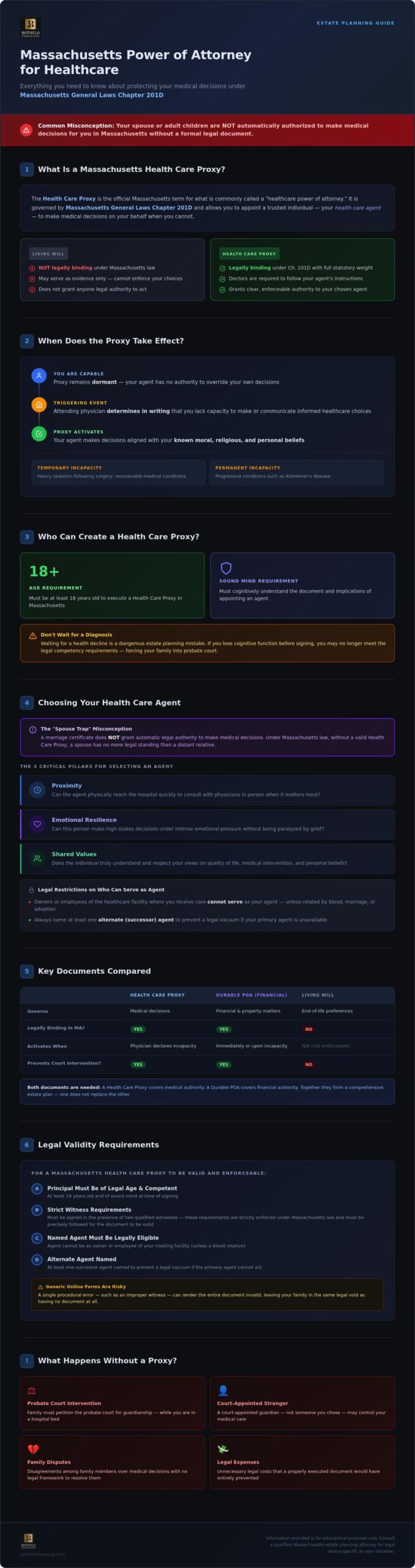
It’s vital to distinguish between a Health Care Proxy and a “Living Will.” While many people use these terms interchangeably, Massachusetts law treats them differently. A Living Will, which outlines your preferences for end-of-life care, isn’t legally binding in this state. It may serve as evidence of your intent, but it doesn’t grant anyone the legal right to enforce those choices. Only a properly executed Health Care Proxy provides the statutory weight necessary to ensure doctors follow your agent’s instructions. Without this document, your medical care could fall into the hands of a court-appointed guardian, potentially leading to family disputes and unnecessary legal expenses.
When Does a Health Care Proxy Take Effect?
Your health care agent doesn’t have the authority to override your decisions while you’re still capable of making them. The proxy remains dormant until your attending physician determines, in writing, that you lack the capacity to make or communicate informed health care choices. This incapacity can be temporary or permanent. For example, you might lose capacity during a brief period of heavy sedation following surgery, or permanently due to a progressive condition like Alzheimer’s. Once the physician makes this determination, the agent’s duty is to make decisions they believe you would have made yourself. They’re legally bound to act according to your known moral, religious, and personal beliefs.
Who Can Create a Health Care Proxy in MA?
Any adult who is at least 18 years old and of sound mind has the legal right to execute a Health Care Proxy. The “sound mind” requirement is a critical legal threshold. You must have the cognitive ability to understand the nature of the document and the implications of appointing an agent. Waiting for a serious diagnosis or a decline in health is a dangerous estate planning mistake. If you lose cognitive function before signing, you may no longer meet the legal competency requirements. This leaves your family in a vulnerable position, often forcing them to navigate the complexities of the probate court to gain the authority that a simple Massachusetts power of attorney for healthcare would have provided instantly.
Selecting Your Health Care Agent: Strategic Considerations
Choosing the right individual to hold your Massachusetts power of attorney for healthcare is a decision that requires both emotional intelligence and legal foresight. Many residents fall into the “spouse trap,” assuming that a marriage certificate grants automatic legal authority to make medical decisions. Under Massachusetts law, this is a dangerous misconception. Without a valid Health Care Proxy, a spouse has no more legal standing than a distant relative or a friend when interacting with medical professionals during a crisis.
Selecting an agent requires evaluating candidates based on three critical pillars:
- Proximity: Can the agent reach the hospital quickly to consult with physicians in person?
- Emotional Resilience: Is the person capable of making high-stakes decisions under intense pressure without being paralyzed by grief?
- Shared Values: Does the individual truly understand and respect your views on quality of life and medical intervention?
It’s also essential to recognize legal boundaries. Massachusetts General Law prevents certain individuals, such as owners or employees of the health care facility where you are receiving care, from serving as your agent unless they are related to you by blood, marriage, or adoption. To ensure your protection remains intact, you should always name at least one alternate agent. If your primary choice is unavailable or unable to act, a successor agent prevents a legal vacuum that could lead to court intervention. For those managing complex family structures or property, consulting with an estate planning professional ensures these designations are legally sound and properly integrated into your broader strategy.
Can You Name Co-Agents in Massachusetts?
While you may feel the urge to name all your children as co-agents to avoid hurt feelings, Massachusetts law and medical providers strongly prefer a single decision-maker. Naming multiple people to act simultaneously often leads to hospital gridlock and conflicting instructions that delay urgent care. A more effective strategy is to name one primary agent and list others as successors in a specific order of priority. This structure provides a clear chain of command while acknowledging the roles of other family members without compromising the speed of your medical treatment.
Discussing Your Wishes with Your Agent
Your agent’s role is to stand in your shoes and make the choices you would make. You must have explicit conversations regarding life-sustaining treatments, such as mechanical ventilation or artificial nutrition and hydration. These discussions should account for your religious beliefs and cultural heritage, which often dictate specific medical preferences. In Massachusetts, courts and agents are guided by the “substituted judgment” standard, which requires the agent to make the specific decision that the incapacitated person would have made if they were competent at that moment.
Comparing Medical POA, Durable POA, and Living Wills
A comprehensive estate plan requires more than a single document. While many people use the term Massachusetts power of attorney for healthcare, it’s essential to understand that this legal instrument specifically addresses medical decisions. It does not grant your agent any authority over your bank accounts, real estate, or retirement funds. To protect your financial interests, you must execute a separate Durable Power of Attorney. These two documents function as the dual pillars of your protection strategy. One ensures your body is cared for according to your values, while the other ensures your bills are paid and your assets are managed without interruption. Working with a power of attorney lawyer in Fall River ensures both instruments are properly coordinated and legally sound under Massachusetts law.
For those managing property, these documents are vital components of a Massachusetts homeowner estate planning strategy. If you become incapacitated, a Health Care Proxy allows your agent to choose a rehabilitation facility, but only a Durable Power of Attorney allows them to access the funds needed to pay for that care. Without this coordination, your family might face a legal deadlock where they have the medical authority to act but lack the financial means to execute those decisions. Additionally, you should recognize that “Living Wills” occupy a unique space in the Commonwealth. Unlike some states where they’re legally binding mandates, Massachusetts courts view Living Wills as “evidence of intent.” They provide a roadmap for your agent and the court, but they don’t carry the same statutory weight as the Health Care Proxy.
The Limitations of the Health Care Proxy
Your health care agent’s power is strictly limited to medical choices. They cannot sign deeds, sell your home, or manage your investment portfolio. Even within the medical sphere, an agent cannot override your conscious objections if you’re currently able to communicate, even if your decision seems irrational to others. Because the boundary between medical necessity and financial solvency is often thin, an asset protection lawyer in Massachusetts typically coordinates these roles. This ensures that your medical agent and your financial attorney-in-fact work in tandem rather than at cross-purposes during a crisis.
The ‘MOLST’ Form vs. The Proxy
It’s also important to distinguish the Health Care Proxy from a Medical Orders for Life-Sustaining Treatment (MOLST) form. A Proxy is a legal document you sign to name a decision-maker. In contrast, a MOLST is a medical order signed by a clinician that translates your preferences into actionable instructions for first responders and hospital staff. While every adult should have a Massachusetts power of attorney for healthcare, MOLST forms are generally reserved for individuals with advanced illness or frailty. Ensuring consistency between your legal Proxy and your medical MOLST form is critical to preventing confusion during emergency medical interventions. For those who may require similar coordination for assets or health directives in other states like Texas, Massingill Attorneys & Counselors at Law provides comprehensive estate planning support to ensure your wishes are protected regardless of location.
Legal Requirements for a Valid Massachusetts Proxy
For a Massachusetts power of attorney for healthcare to hold weight in a clinical setting, it must strictly adhere to the execution standards defined in M.G.L. c. 201D. The law requires that you sign the document in the presence of two competent adult witnesses who must also sign the document in your presence. These witnesses serve as a legal safeguard, attesting that you are of sound mind and free from undue influence at the moment of execution. While Massachusetts doesn’t require a notary public for a Health Care Proxy, obtaining a notary’s seal is a prudent step for residents who travel frequently or own property in other states, as it enhances the document’s portability and acceptance across state lines.
Once your document is correctly executed, storage is a matter of strategic importance. A Health Care Proxy is useless if it’s locked in a safe deposit box where no one can find it during an emergency. You should provide copies to your primary care physician, any specialists you see regularly, and your local hospital. Most importantly, your designated agent and alternate agents must have their own copies. If you’re concerned that your current documentation might not survive a legal challenge, contact Botelho Law Group to secure a professionally drafted estate plan that meets every statutory requirement.
Common Execution Errors to Avoid
The most frequent error that voids a Massachusetts power of attorney for healthcare involves witness eligibility. Your named health care agent is legally barred from serving as a witness to your signature. If your agent’s name appears on the witness line, the document is invalid. Another common misconception is the “stale document” myth. In Massachusetts, a Health Care Proxy does not expire; it remains valid until you revoke it or sign a new one. However, major life events, such as a divorce, require immediate attention. By law, if you’ve named your spouse as your agent and you later divorce or receive a legal separation, their authority is automatically revoked unless your document explicitly states otherwise. For families navigating these complex transitions, the Law Offices of Matthew T. Desrochers, P.C. offers expert guidance in family law and debt relief to ensure your legal protections remain current and effective.
Revoking or Changing Your Agent
You maintain the absolute right to revoke your Health Care Proxy at any time. This can be done through a written revocation, an oral statement in the presence of a witness, or any other act that clearly demonstrates your intent to cancel the document. The most effective method is to execute a new Proxy, which legally supersedes any prior versions. When you make a change, you must notify your medical providers immediately. Hospitals and doctors will continue to follow the instructions of the agent named in the document they have on file until they receive formal notice of a change or revocation. This ensures there’s no ambiguity regarding who holds the legal authority to speak for you.
Why Professional Legal Guidance Trumps Generic Forms
Generic forms found online often provide a false sense of security. While these templates might satisfy basic signature requirements, they fail to account for the intricate realities of your life and the specific rigor of the Massachusetts legal system. A flawed or incomplete Massachusetts power of attorney for healthcare is a liability that often isn’t discovered until a medical crisis has already begun. When a hospital’s legal department rejects a generic form due to ambiguity or improper execution, your family is left with only one option: a costly and public petition for guardianship in the probate court. This process is time-consuming, emotionally draining, and strips you of the autonomy you intended to preserve. Engaging a dedicated power of attorney lawyer in Fall River is the most reliable way to ensure your documents are drafted to withstand scrutiny and protect your autonomy when it matters most.
Professional legal guidance ensures that your medical directives are integrated into a broader asset protection plan. For homeowners in Fall River and surrounding areas, a medical emergency is rarely just a medical issue; it’s a financial and legacy issue. If your medical agent and your financial representative aren’t operating under a coordinated legal framework, your care could be compromised by administrative gridlock. We also address the specific needs of our local community, including providing Portuguese-speaking staff to ensure that every nuance of your medical wishes is captured accurately. For those who live near the border or seek treatment in Rhode Island, we ensure your documents are drafted to withstand scrutiny across state lines. To further protect your assets from the lengthy Bristol County probate process, working with a revocable living trust attorney in Fall River ensures your estate transfers seamlessly to your loved ones without court intervention.
If your planning involves business assets outside of Massachusetts, particularly in the South Florida area, you may click here to learn how professional business law services can help secure your corporate interests as part of a comprehensive protection plan.
The Botelho Law Group Approach to Medical Directives
Our firm views a Health Care Proxy as a tool for protective advocacy. We don’t just provide a document; we build a strategic shield that ensures your voice is heard in the ICU as clearly as it is in the courtroom. Our process involves a comprehensive review of all your estate planning documents to ensure there is zero conflict between your medical wishes and your financial protections. This level of precision provides the peace of mind that Fall River families and homeowners deserve, knowing that their legacy is secure from every angle and every potential legal challenge.
Next Steps: Securing Your Healthcare Autonomy
The time to address your Massachusetts power of attorney for healthcare is while you are healthy and capable of making deliberate choices. Waiting for a diagnosis or a sudden injury removes your ability to choose your own advocate. Professional document preparation is the only way to ensure your wishes are followed during high-stakes medical crises. We invite you to schedule a consultation to review your current estate plan and identify any vulnerabilities in your current directives. Secure your medical future with a professional Health Care Proxy by contacting our office today.
Protecting Your Legacy and Medical Autonomy
Establishing a robust medical directive is a critical step in protecting your dignity and your family’s peace of mind. By formalizing a Massachusetts power of attorney for healthcare, you ensure that your medical treatment remains a private matter guided by your personal values rather than a public proceeding in the probate court. We’ve explored the necessity of naming a resilient agent, the strict witness requirements of Chapter 201D, and the strategic importance of coordinating your medical proxy with a durable power of attorney to create a seamless shield for your assets and your health.
Botelho Law Group brings decades of experience in Massachusetts General Laws to every estate plan we draft. As Fall River’s trusted full-service law firm, we maintain a specialized focus on asset protection to ensure your legacy remains intact regardless of what the future holds. Many families who have already secured a Health Care Proxy also benefit from consulting a Fall River living trust attorney to keep their estate out of the probate court entirely and preserve their wealth for future generations. Don’t leave your most critical medical decisions to chance or generic forms that may fail when you need them most. Our team is ready to act as your dedicated advocate and strategist. Schedule a Consultation with a Massachusetts Estate Planning Attorney today to fortify your future. You’ve worked hard to build your life; it’s time to ensure it’s protected.
Frequently Asked Questions
Is a Massachusetts Health Care Proxy the same as a Power of Attorney?
A Health Care Proxy is the specific legal instrument used as a Massachusetts power of attorney for healthcare. While a standard Power of Attorney typically grants authority over financial and legal matters, the Proxy is limited to medical decision-making. It’s a specialized document designed to ensure that your medical treatment aligns with your personal wishes when you’re unable to communicate them yourself.
Do I need a lawyer to create a Health Care Proxy in Massachusetts?
You aren’t legally required to hire an attorney to sign a Health Care Proxy, but professional guidance is highly recommended to avoid execution errors. Generic forms often lack the specificity needed to handle complex family dynamics or specific medical preferences. An attorney ensures the document is executed according to M.G.L. c. 201D, preventing common witness errors that could void your agent’s authority during a crisis.
Can I name more than one person as my health care agent?
Massachusetts law requires you to name one primary agent to avoid conflicting instructions and hospital gridlock. You cannot name co-agents to act simultaneously. Instead, you should name one primary individual and at least one alternate agent who can step in if the first person is unavailable. This structure provides a clear chain of command for medical providers and prevents delays in your care.
What happens if I don’t have a Health Care Proxy in Massachusetts?
Without a valid Proxy, your loved ones lack the legal authority to make medical decisions if you’re unable to speak. They’ll likely be forced to file a petition for guardianship in the probate court to gain that authority. This process is public, expensive, and can take weeks to resolve, leaving your medical care in a state of uncertainty during a critical time when every moment counts.
Does a Health Care Proxy need to be notarized in MA?
Notarization isn’t a legal requirement for a Health Care Proxy under Massachusetts law. The document only requires the signatures of two competent adult witnesses who aren’t named as the agent. However, including a notary’s seal is a strategic addition for those who travel or own property in other states, as it increases the document’s likelihood of being accepted outside of the Commonwealth.
Can my health care agent make financial decisions for me?
Your health care agent’s authority is strictly limited to medical treatment and care decisions. They cannot access your bank accounts, pay your bills, or manage your real estate. To grant someone authority over your financial assets, you must execute a separate Durable Power of Attorney. These two documents work together to provide comprehensive protection during periods of incapacity.
How do I choose the right person to be my health care agent?
The best agent is someone who shares your values and possesses the emotional resilience to make difficult decisions under pressure. You should choose an individual who lives close enough to be physically present at the hospital and who is willing to follow your specific instructions, even if they personally disagree with them. It’s a role that requires a high degree of trust and clear communication.
Will my Massachusetts Health Care Proxy be valid in other states?
Most states will honor a Massachusetts power of attorney for healthcare if it was validly executed in the state where you lived at the time. However, laws regarding medical directives vary across state lines. If you spend significant time in another state, such as Rhode Island, it’s wise to have your documents reviewed by an attorney to ensure they meet the specific statutory requirements of that jurisdiction.
For families with international legal needs or those navigating family law systems in other countries, you can check out Salior Ben Hamou Law Office for specialized support and guidance in Israel.
Additionally, if your estate planning needs extend to international inheritance matters involving Germany and Russia, you can discover Адвокатское бюро Кобрель for specialized legal expertise.