
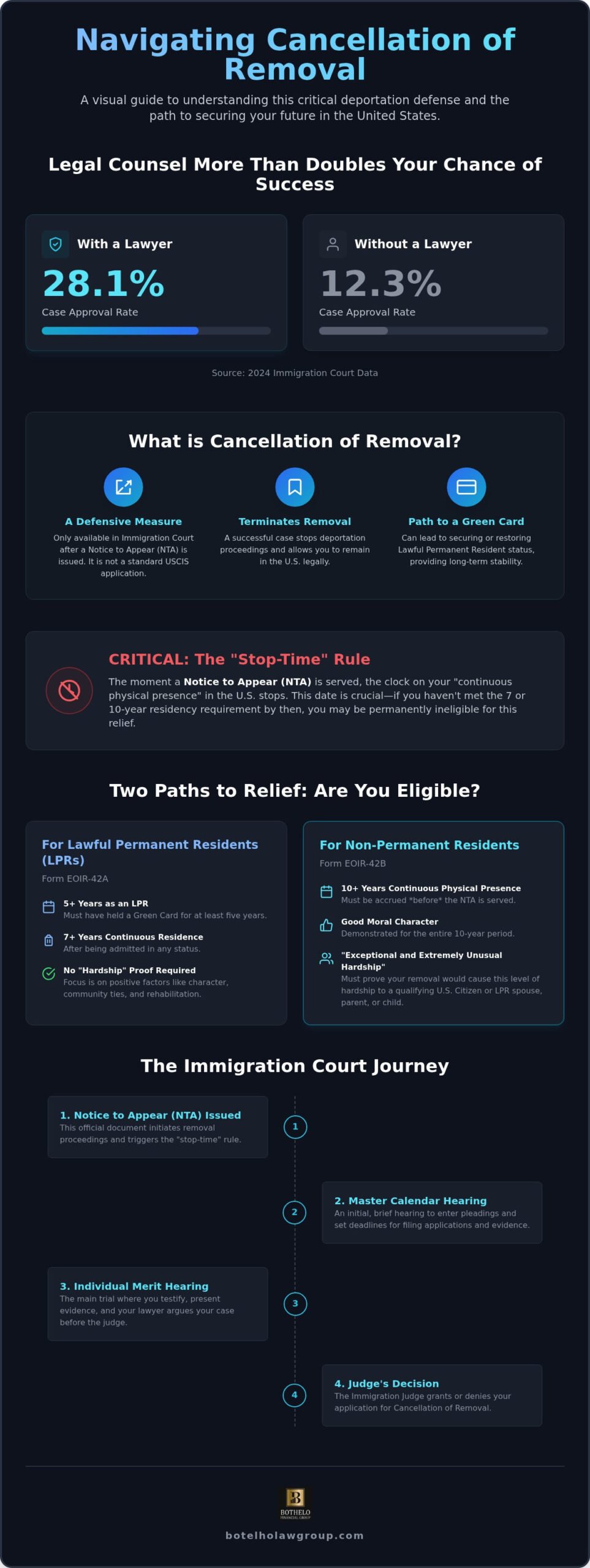
Did you know that non-permanent residents facing deportation are more than twice as likely to win their case when they have professional legal counsel? According to 2024 data, represented applicants saw a 28.1% approval rate compared to just 12.3% for those standing alone. You’re likely feeling the immense weight of this situation, perhaps fearing a permanent separation from your U.S. citizen children or spouse. The complexity of eligibility dates and the high stakes of testifying before an immigration judge can feel overwhelming when your entire future is on the line.
This guide demonstrates how a skilled cancellation of removal lawyer acts as a sophisticated strategist to defend your right to stay in the United States and secure your Green Card. We’ll examine the specific legal standards for residents, including the critical “stop-time” rule that can abruptly halt your eligibility. You’ll also learn how to document the “exceptional and extremely unusual hardship” necessary to meet the high evidentiary bars set by the court. By understanding the methodical approach required for a successful deportation defense, you can move toward the peace of mind that comes with a protected family and a permanent legal status.
Key Takeaways
- Identify how cancellation of removal serves as a vital legal defense to terminate deportation proceedings and potentially secure a Green Card.
- Distinguish between the specific residency and eligibility requirements for Lawful Permanent Residents versus non-permanent residents.
- Understand the rigorous “exceptional and extremely unusual hardship” standard and why documentation must focus on your qualifying U.S. relatives.
- Learn why a dedicated cancellation of removal lawyer is essential for navigating the complex procedural rules and high-stakes environment of the immigration court.
- Gain a clear overview of the Massachusetts court process, from the initial Master Calendar Hearing to the final Individual Merit Hearing.
Understanding Cancellation of Removal as a Deportation Defense
When an individual faces the threat of deportation, Cancellation of removal serves as a powerful, though complex, form of relief. It’s not an administrative application you file with USCIS; instead, it’s a defensive measure available only during proceedings in Immigration Court. Successfully winning this case allows an individual to terminate their removal and potentially secure or restore Lawful Permanent Resident status. It’s vital to recognize that this is a discretionary benefit. An Immigration Judge isn’t required to grant it simply because you meet the basic criteria. They must be convinced that your case warrants a favorable exercise of discretion based on your character, family ties, and overall contributions to the community. This defense is typically triggered by the service of a Notice to Appear (NTA), which officially places you in removal proceedings.
The Notice to Appear and the ‘Stop-Time’ Rule
The arrival of a Notice to Appear marks the official start of your removal case. It also triggers a critical legal mechanism known as the Stop-Time Rule. This rule effectively halts the clock on your period of continuous physical presence in the United States. Many individuals mistakenly believe they continue to accrue the required years of residency while their court case is pending. This is a dangerous assumption. The Stop-Time Rule defines the exact moment your residency period ends for the purpose of eligibility. If the NTA is served before you reach the required seven or ten years of residency, you may be permanently barred from this specific form of relief. This makes the date on your NTA one of the most significant pieces of evidence in your entire file.
Why You Need a Removal Proceedings Attorney Early
Securing a cancellation of removal lawyer immediately after receiving an NTA is a strategic necessity. The national immigration court backlog currently exceeds 3.7 million cases. This volume puts intense pressure on the approximately 570 active immigration judges to move through their dockets with speed. Consequently, judges grant fewer continuances. If you aren’t prepared at your first hearing, you risk an “in absentia” removal order, a trend that rose by 31% in 2025. A focused advocate identifies potential criminal bars early. Certain convictions can immediately disqualify you from relief, even if you’ve lived in the U.S. for decades. Early representation ensures that your evidence for the residency requirement is meticulously organized and authenticated. In communities like Fall River, having a representative who understands both federal law and local nuances provides the systematic approach needed to protect your future. If a loved one has been detained by ICE, working with an experienced immigration bond hearing lawyer to secure release quickly can be the critical first step before pursuing cancellation of removal.
Eligibility Requirements for LPRs and Non-Permanent Residents
Eligibility for relief depends on your current legal status at the time removal proceedings begin. The Executive Office for Immigration Review (EOIR) provides two primary avenues: Form EOIR-42A for Lawful Permanent Residents and Form EOIR-42B for those without a Green Card. A dedicated cancellation of removal lawyer helps navigate these distinct paths, as each carries its own set of evidentiary burdens. According to the Legal Information Institute, both paths require the applicant to demonstrate “Good Moral Character” during the relevant statutory period. This standard is subjective. The judge examines your entire history, from tax compliance to community involvement. Certain “bars” to relief exist, including convictions for aggravated felonies or involvement in security-related threats, which can result in an automatic denial regardless of residency length.
Cancellation for Lawful Permanent Residents (42A)
For those who already hold a Green Card, the eligibility threshold is focused on time and conduct rather than family hardship. You must have been a Lawful Permanent Resident for at least five years and have resided in the U.S. continuously for at least seven years after being admitted in any status. An immigration lawyer Fall River MA often focuses on defending against “removability” by challenging the classification of past criminal convictions. Unlike non-residents, LPRs aren’t required to prove that their deportation would cause “exceptional hardship” to a relative. The focus remains on whether your positive factors outweigh the negative conduct that triggered the court case.
Cancellation for Non-Permanent Residents (42B)
The requirements for non-residents are significantly more rigorous. You must prove ten years of continuous physical presence in the country. Documentation is paramount here. Judges look for a clear, unbroken paper trail of leases, tax returns, and employment records. Additionally, you must have a “qualifying relative” who is a U.S. citizen or Lawful Permanent Resident spouse, parent, or child. For non-LPRs, winning a case through a cancellation of removal lawyer results in an immediate adjustment to Lawful Permanent Resident status, granting a Green Card directly from the judge.
The national approval rate for non-LPR cases was 22.6% in fiscal year 2024, but that number rose to 28.1% for those with legal representation. This data highlights the critical nature of professional advocacy in high-stakes litigation. If you’re unsure which path applies to your specific situation, it’s wise to consult with a firm specializing in deportation defense to review your eligibility.
Proving ‘Exceptional and Extremely Unusual Hardship’
Meeting the statutory requirements for cancellation of removal is only the first step. For non-permanent residents, the most significant hurdle is proving “exceptional and extremely unusual hardship.” This standard is substantially higher than the “typical” hardship associated with deportation. Every family suffers when a loved one is removed, but for this defense to succeed, you must demonstrate that your qualifying relatives would face suffering that is unique and severe. Crucially, the law focuses entirely on the hardship to your U.S. citizen or Lawful Permanent Resident spouse, parent, or child. Hardship to you, the applicant, is not considered for this specific legal threshold. According to ICE data from 2024, 47% of denials were caused by insufficient evidence of this hardship, illustrating why a meticulous evidentiary strategy is required.
The Evidence Needed to Win a Hardship Claim
A cancellation of removal lawyer builds a case by compiling objective, third-party documentation that illustrates your family’s specific vulnerabilities. This often includes chronic medical records for a relative, psychological evaluations detailing the trauma of separation, or school Individualized Education Programs (IEPs) for children with special needs. Financial records are equally vital; you must show that your qualifying relatives are totally dependent on your income for their basic survival and medical care. In many cases, we utilize country condition reports to demonstrate that a relative would face physical danger or a total lack of necessary medical treatment if they were forced to relocate with you. To be successful, “exceptional hardship” requires proving that the relative would suffer significantly more than a typical family facing separation.
The Discretionary Factor: Good Moral Character
Even with strong hardship evidence, the Immigration Judge must decide if you deserve to stay. This is where the discretionary factor of “Good Moral Character” becomes central. The judge performs a balancing test, weighing “positive factors” like consistent tax filings and community service against “negative factors” such as past arrests or immigration violations. Character reference letters from the local Fall River or Massachusetts community play a vital role in this process. These letters should speak to your work ethic, family dedication, and community contributions. During testimony, it’s essential to address past mistakes or minor criminal records with transparency and remorse. A focused advocate prepares you for these difficult questions, ensuring the judge sees a complete picture of your life and your value to the community.
The Immigration Court Process in Massachusetts
Receiving a Notice to Appear (NTA) in Massachusetts initiates a rigid procedural timeline that can span several years. While the national backlog continues to grow, cases in the Boston Immigration Court often face wait times ranging from two to six years for a final merits hearing. This delay is a double-edged sword. It provides necessary time for a cancellation of removal lawyer to compile a massive volume of evidence, but it also means living under a cloud of uncertainty for an extended period. A systematic defense strategy requires precise management of every court appearance to ensure you don’t lose your one opportunity for relief through procedural default.
Master Calendar vs. Individual Merit Hearings
The process begins with the Master Calendar Hearing. This is a brief, procedural appearance where you must plead to the charges listed in the NTA and designate a country of removal. While it may seem routine, the decisions made here set the legal framework for your entire case. In contrast, the Individual Merit Hearing functions as a full trial. This is where your immigration court representation in Massachusetts presents your complete narrative through witness testimony and physical exhibits. You must adhere strictly to the “call-up” date, which is the court-mandated deadline for filing all pre-trial motions and evidence. If documents are submitted after this date, the judge may refuse to consider them, potentially gutting your hardship claim at the last moment.
The Role of Testimony and Expert Witnesses
Live testimony is the engine of a successful cancellation case. Family members must be prepared to testify about the specific, “exceptional and extremely unusual hardship” they would face if you were removed. This is often an emotional and grueling process. To bolster the written record, we frequently integrate expert witnesses, such as medical professionals to document chronic health conditions or country-condition experts who can speak to the dangers in your home nation. The applicant’s own testimony is the most critical piece of evidence for establishing credibility and moral character. You will face intense cross-examination from government attorneys who are trained to find inconsistencies in your history. Maintaining composure and providing precise, honest answers is essential for winning the judge’s favorable discretion.
Navigating the complexities of the JFK Federal Building in Boston requires a strategist who understands the specific preferences of local judges. If you are currently facing a scheduled hearing, secure the dedicated advocacy of Botelho Law Group to protect your right to remain with your family.
Why Strategic Representation Matters for Your Removal Case
Choosing a cancellation of removal lawyer is a decision that impacts every facet of your life, from your physical presence in the country to the financial security of your children. At Botelho Law Group, we act as a focused advocate for families in the Fall River community and across the nation. Our firm’s depth of knowledge as a cancellation of removal lawyer allows us to anticipate the strategies used by government counsel while maintaining a calm, authoritative presence in court. We don’t just view your case as a series of court dates; we see it as a critical mission to protect your American dream. Our Portuguese-speaking capabilities ensure that members of our local community receive clear communication during the most stressful time of their lives. By combining a deep understanding of federal immigration law with specific knowledge of local Massachusetts court dynamics, we provide the sophisticated problem-solving necessary to navigate these complex systems.
Beyond Deportation: Protecting Your Family’s Future
A successful defense in immigration court is the foundation for a comprehensive family strategy. Winning your case doesn’t just stop a deportation; it opens the door for long-term family based green card attorney planning. Once your status is secure, you can focus on protecting what you’ve built. For mixed-status families, the intersection of immigration law and estate planning is vital. We help clients ensure their assets and children are protected through robust asset protection strategies. Securing your immigration status also makes it the right time to work with a power of attorney lawyer Fall River residents trust to ensure a designated person you choose, rather than a court-appointed stranger, controls your medical and financial decisions if you’re ever unable to communicate your wishes. A stable legal status also reinforces your ability to own property safely and pursue legitimate personal injury litigation if you’ve been harmed. Our multi-disciplinary expertise ensures that while we fight for your status today, we’re also securing your legacy for tomorrow.
Taking the First Step: The Consultation
The only way to determine your true eligibility for relief is through a comprehensive, results-oriented case evaluation. Generic advice cannot account for the specific nuances of your entry dates, criminal history, or family hardships. During a consultation, we perform a deep dive into your records to identify the most effective path forward. To make the most of this meeting, you should come prepared with specific documentation. Please bring your Notice to Appear (NTA), any records of past arrests or convictions, and birth certificates for your U.S. citizen or permanent resident relatives. This information allows us to build a methodical defense from day one. You don’t have to face the uncertainty of the immigration system alone. Contact Botelho Law Group today for a removal defense evaluation and take control of your future.
Secure Your Future and Protect Your Family
Navigating the threat of deportation requires more than just meeting basic residency requirements. It demands a sophisticated defense that addresses the high evidentiary bar of “exceptional and extremely unusual hardship” while managing the rigid procedural rules of the immigration court system. You now understand that while the process is discretionary, a systematic approach to documenting your family’s ties and community contributions can significantly shift the outcome in your favor. This defense is your last stand to transform a removal proceeding into a path for permanent residency.
A dedicated cancellation of removal lawyer acts as your strategic partner in this high-stakes environment. Botelho Law Group provides focused advocacy for Fall River families and handles complex immigration litigation for clients across all 50 states. We specialize in protecting your American dream by ensuring every legal avenue is explored with precision and authority. You don’t have to face the complexities of the immigration judge’s chambers without a relentless fighter on your side.
Schedule Your Deportation Defense Consultation with Botelho Law Group
Your future in the United States is the foundation of your family’s long-term security. With professional representation, you can face your court date with the confidence that your right to stay is being defended by a seasoned expert.
Frequently Asked Questions
Can I apply for cancellation of removal if I don’t have a green card?
Yes, non-permanent residents can apply for relief through a process known as Non-LPR Cancellation of Removal under Form EOIR-42B. You must currently be in removal proceedings in immigration court to request this benefit. Eligibility requires ten years of continuous physical presence in the United States and a showing of exceptional and extremely unusual hardship to a qualifying U.S. citizen or permanent resident relative.
What is the 10-year rule for cancellation of removal?
The 10-year rule requires non-permanent residents to prove they’ve been physically present in the U.S. for at least ten years before receiving a Notice to Appear. Under the Stop-Time Rule, the clock stops the moment the government serves you with the NTA. If you haven’t reached the ten-year mark by that exact date, you’re generally disqualified from seeking this specific form of relief.
Does a criminal record automatically disqualify me from cancellation of removal?
A criminal record doesn’t always result in an automatic denial, but certain convictions act as statutory bars. Aggravated felonies or crimes involving moral turpitude can make you ineligible for relief. A cancellation of removal lawyer must perform a detailed analysis of your records to determine if your past mistakes trigger these bars or if they can be mitigated through evidence of good moral character. Similarly, for those facing intricate legal issues abroad, such as high-complexity criminal defense in Chile, merinoyabogadosasociados.cl offers specialized expertise to navigate those specific challenges.
What happens if my application for cancellation of removal is denied?
If the immigration judge denies your application, they’ll typically issue an order of removal. You have the right to challenge this decision by filing an appeal with the Board of Immigration Appeals. As of March 9, 2026, the deadline to file a Notice of Appeal is just 10 days. It’s critical to act immediately because BIA review is now discretionary and requires a majority vote to accept the case. If the BIA also rules against you, working with a dedicated motion to reopen deportation case lawyer may provide an additional avenue to challenge the final order of removal and present new evidence that could change the outcome.
How much does a cancellation of removal lawyer cost in Massachusetts?
Legal fees for deportation defense vary significantly based on the complexity of the case and the volume of evidence required for the hardship claim. High-stakes litigation involves multiple hearings, expert witness coordination, and extensive document preparation. You should discuss fee structures during a comprehensive case evaluation to understand the resources needed for a systematic defense of your residency rights.
Can I get a work permit while my cancellation of removal case is pending?
Yes, you’re eligible to apply for an Employment Authorization Document once your application for cancellation is officially filed with the immigration court. This work permit allows you to maintain legal employment while you wait for your merit hearing. Given that court backlogs can result in wait times of several years, maintaining a valid work permit is essential for supporting your family during the process.
Who counts as a ‘qualifying relative’ for hardship purposes?
For the purposes of a non-LPR cancellation case, a qualifying relative is limited to a spouse, parent, or child who is a U.S. citizen or Lawful Permanent Resident. Hardship to the applicant themselves doesn’t count toward the legal standard. You must prove that these specific relatives would suffer exceptional and extremely unusual consequences if you were removed from the country.
Is there a limit on how many people can be granted cancellation of removal each year?
Yes, there’s a statutory cap of 4,000 grants per fiscal year for non-permanent resident cancellation of removal cases nationwide. If the limit is reached before your case is decided, the judge may grant your application “subject to the cap.” This means you’ll receive a final order and your Green Card only when a number becomes available in a future fiscal year.