
In 2026, proving you possess Good Moral Character for U.S. citizenship is no longer just about the absence of a criminal record. It’s about providing active, documented proof of your positive impact on the American community. You’ve worked hard to build a life here, and it’s natural to feel anxious that a minor past mistake or a complex financial history might suddenly derail your N-400 application. The fear that a single oversight could lead to a denial is a heavy burden to carry as your interview date approaches.
Navigating these legal hurdles can be mentally taxing, making it helpful to find tools for focus and clarity. To maintain your inner balance during this transition, visit Ganhwaseon – koreanischer Zen nach Subul for resources on Korean Zen and coaching designed to help you stay grounded.
We understand that the current “totality of circumstances” rule can feel unpredictable and confusing. That’s why many applicants choose to consult a good moral character for citizenship lawyer to ensure their file is strategically prepared. This article provides a comprehensive checklist designed to protect your path to citizenship. You’ll learn exactly which documents to bring to your interview, how to present positive equities like tax compliance and community involvement, and how to answer difficult questions with total confidence. By following this structured approach, you can transform a high-stakes interview into a clear path toward your American dream.
Key Takeaways
- Understand the mandatory Good Moral Character requirements and how the three or five year statutory period applies to your specific N-400 application.
- Learn how the 2026 shift toward a “totality of circumstances” review allows you to offset past mistakes with documented proof of positive community contributions.
- Identify critical red flags, such as tax debt or minor citations, that necessitate the strategic intervention of a good moral character for citizenship lawyer.
- Access a focused checklist of original documents and certified records you must present to the USCIS officer to avoid delays or denials.
- Discover how conducting mock interviews and building a robust evidence file can instill the confidence needed to navigate high-stakes officer questioning.
What is Good Moral Character (GMC) for U.S. Citizenship?
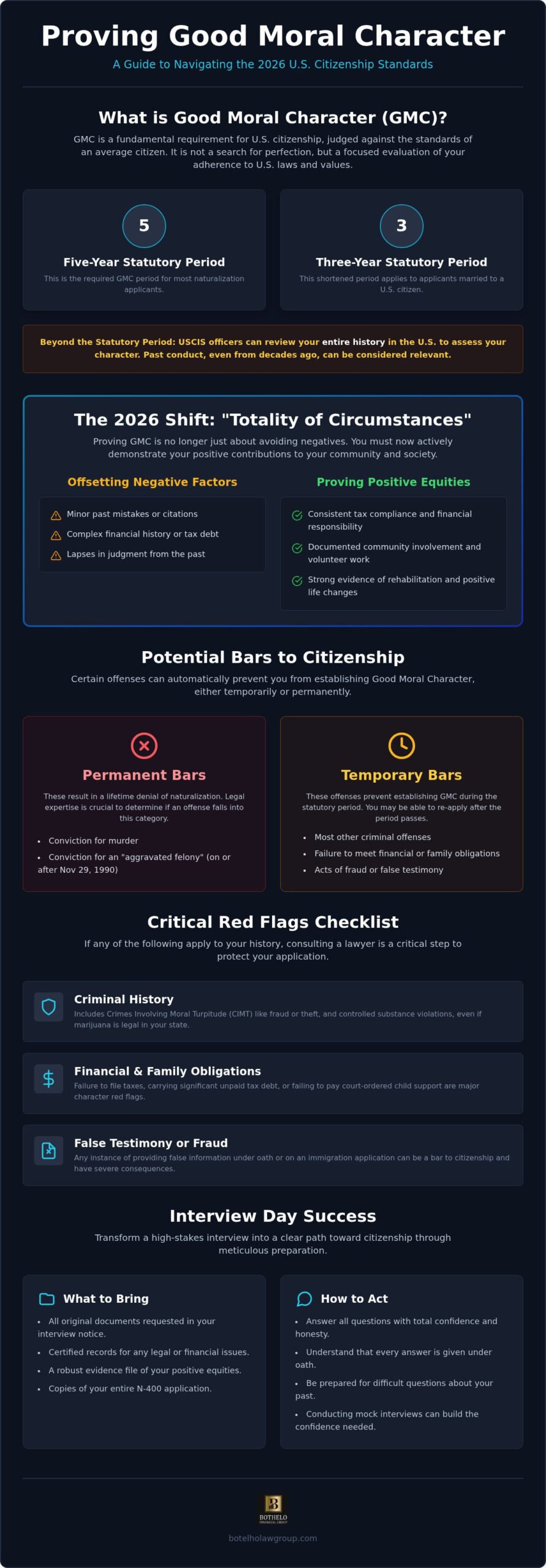
Establishing Good Moral Character (GMC) is a fundamental pillar of the naturalization process. Under Section 316(a) of the Immigration and Nationality Act (INA), every applicant must prove they’ve been a person of good moral character during the specific “statutory period” preceding their application. For most filers, this period is five years. However, if you’re applying based on marriage to a U.S. citizen, the requirement is shortened to three years. Proving this isn’t just a formality; it’s a rigorous legal standard that requires clear documentation and a strategic approach.
While the statutory period is the primary focus, USCIS officers possess the authority to examine your conduct throughout your entire life in the United States. This is where many applicants face unexpected challenges. A What is Good Moral Character? assessment is a measure of a person’s standards compared to average community members. It isn’t a search for perfection, but it is a focused evaluation of your fitness for citizenship and your adherence to the laws of this country.
The law categorizes character issues into two main groups: permanent bars and temporary bars. Permanent bars, such as a conviction for murder or an “aggravated felony” committed on or after November 29, 1990, will result in a lifetime denial. Temporary bars are offenses that prevent you from establishing GMC during the statutory period but may allow for a future application once that period has passed. Determining which category a past incident falls into requires deep legal expertise.
The Five-Year Rule vs. Your Entire History
Don’t assume that a mistake made ten or twenty years ago is irrelevant to your current application. USCIS policy allows adjudicators to look beyond the statutory period if an applicant’s earlier conduct is relevant to their current character. For instance, if you had a series of arrests fifteen years ago and a single incident recently, the officer might view this as a lifelong pattern of lawbreaking rather than an isolated lapse in judgment. Strategic preparation with a good moral character for citizenship lawyer is vital here. We focus on presenting extenuating circumstances and evidence of rehabilitation to show that your past does not define your present.
Common Misconceptions About Character
A common trap for applicants is believing that a clean criminal record equals a guaranteed approval. GMC covers much more than just arrests. USCIS considers financial responsibility and family obligations as core components of your character. Failing to file tax returns, carrying significant unpaid tax debt, or falling behind on court-ordered child support payments can lead to a finding that you lack the required character for citizenship. Engaging a sophisticated immigration lawyer Fall River MA ensures that these non-criminal “red flags” are addressed before you step into the interview room. We help you build a file of positive factors to balance out any historical weaknesses.
The GMC Checklist: Red Flags That Require a Lawyer
The N-400 interview is a formal legal proceeding where every answer is given under oath. For many applicants, the most challenging portion involves the “Have you ever” questions designed to uncover potential bars to citizenship. Identifying these red flags early is essential for a successful outcome. If your history contains any of the following issues, consulting a good moral character for citizenship lawyer is a critical step in protecting your legal status.
Crimes Involving Moral Turpitude (CIMT) remain a primary focus for adjudicators in 2026. These offenses involve conduct that is inherently base, vile, or contrary to the accepted rules of morality. Because the definition of a CIMT can be subjective and varies by jurisdiction, USCIS officers rely on the USCIS Policy Manual on Good Moral Character to determine if an offense triggers a bar. Common examples include fraud, theft, and certain assault charges. Additionally, controlled substance violations present a unique trap. Even in states where marijuana is legalized, any admission of use or possession remains a federal offense that can lead to a finding of lack of GMC.
Financial and administrative obligations are equally weighted. Failure to file federal, state, or local taxes is viewed as a significant character flaw. Similarly, failing to support dependents or neglecting court-ordered child support payments can result in an immediate denial. Finally, any instance of false testimony or fraud used to obtain an immigration benefit is considered a permanent blot on your record. Truthfulness is the baseline for all naturalization approvals.
Criminal Records and Expungements
A common misconception is that an expunged or sealed record is invisible to immigration authorities. For USCIS purposes, an expungement does not “erase” the conviction. You must disclose the arrest and provide certified court dispositions. However, the “Petty Offense Exception” may offer relief if you have only one conviction for a CIMT, the maximum possible penalty didn’t exceed one year, and you weren’t sentenced to more than six months. When criminal issues threaten your residency, a specialized cancellation of removal lawyer can provide the aggressive defense needed to mitigate these bars.
Civil and Financial Red Flags
Men who lived in the U.S. between the ages of 18 and 26 must have registered for Selective Service. Failing to do so can be viewed as a “willful failure” to comply with federal law, though this often becomes less of an issue after age 31. Regarding financial debt, the IRS is a major factor. If you owe back taxes, you must present a “good faith” payment plan and proof of consistent payments to demonstrate responsibility. You should also verify that you never accidentally registered to vote, as “false claims to U.S. citizenship” are extremely difficult to overcome without expert guidance. If you are concerned about your eligibility, reviewing your file with a professional specializing in naturalization and citizenship applications can help you identify and resolve these issues before your interview.
The 2026 Shift: Proving Positive Contributions
For decades, the naturalization process felt like a binary test where you either had a disqualifying conviction or you didn’t. In 2026, the standard has evolved into a “totality of the circumstances” review. This means USCIS officers are now trained to actively weigh your positive contributions against any historical mistakes. It’s no longer sufficient to simply show you’ve stayed out of trouble. You must demonstrate that you’re a person who adds value to the American community. This holistic approach requires a shift in how you prepare your case. Before diving into character evidence, it’s equally important to understand how to apply for US citizenship under the complete 2026 legal framework, as the N-400 process itself is a final audit of your entire immigration history.
This policy change makes the preparation of your character evidence file as important as the application itself. An officer reviews the USCIS definition of Good Moral Character and looks for evidence that your presence in the U.S. serves the public interest. When you work with a good moral character for citizenship lawyer, the goal is to move the officer’s focus from “is this person eligible?” to “is this person an asset?” We help you curate a portfolio that highlights your civic participation, professional growth, and family dedication to ensure your file reflects your true character.
Documenting Your Community Impact
Documenting your community impact requires more than just a list of organizations. You need high-quality letters of recommendation from individuals who can speak to your integrity with specificity. These letters should come from employers, religious leaders, or community organizers who’ve witnessed your character in action over several years. Sustained community involvement can often serve as the decisive factor that allows an officer to overlook minor discretionary red flags. Whether it’s coaching a local youth team or consistently volunteering at a food bank, these actions provide tangible proof of your moral standing that goes beyond a simple background check.
Family and Employment Stability
Stability is a hallmark of good character in the eyes of USCIS. Adjudicators view consistent employment and the pursuit of higher education or professional certifications as clear indicators of a responsible and productive citizen. Family ties are equally persuasive. If you’ve acted as a primary caregiver for an elderly parent or a child with special needs, these responsibilities demonstrate a level of selflessness and reliability that officers respect. Many of our clients began this journey years ago with a family based green card attorney, and we use that long history of legal compliance to show a steady, upward trajectory. By presenting a life defined by stability and contribution, you provide the officer with the necessary evidence to approve your application with confidence.
Interview Day Checklist: What to Bring and How to Act
The naturalization interview is a formal legal proceeding where your verbal testimony carries the same weight as your written application. While many applicants spend weeks studying for the civics test, the true legal hurdle is often the “Have you ever” section of the N-400. This portion of the interview is specifically designed to test your honesty and establish your moral standing. Engaging a good moral character for citizenship lawyer ensures you walk into the USCIS office with a rebuttal file prepared to address any potential concerns the officer might raise.
Preparation begins with the “Golden Rule” of immigration interviews: never guess and never lie. If you don’t understand a question, ask the officer to rephrase it. If you don’t remember a specific date, it’s better to state that you don’t recall than to provide a false answer. Inconsistencies between your testimony and your record are often interpreted as a lack of good moral character, even if the error was unintentional. If the officer identifies a gap in your evidence, they may issue a Request for Evidence (RFE). An RFE isn’t a denial, but it is a high-stakes demand for specific documentation that must be handled with precision to avoid a negative decision.
The Essential Document Folder
Organization is a signal of character and responsibility to the adjudicating officer. You must bring original documents for your own reference, but be prepared to provide certified copies if the officer needs to keep them for your file. Your folder should include tax transcripts from the IRS for the last five years, or three years if you’re applying as the spouse of a U.S. citizen. If you’ve ever had a legal encounter, including traffic citations or dismissed charges, you must bring certified court dispositions. Additionally, bring proof of your financial obligations, such as records of child support payments or active tax installment agreements. These documents serve as your primary defense against claims of financial irresponsibility or legal non-compliance.
Strategic Communication with the Officer
Officers sometimes use “trick” questions or broad inquiries to see if you’ll admit to conduct that wasn’t explicitly listed in your application. For example, questions about your travel history or associations are often probes into your continuous residence or organizational ties. During these moments, your attorney acts as a protective shield, ensuring the officer remains within the bounds of the law. You have the right to ask your attorney to clarify a legal point if a question feels ambiguous or outside the scope of the N-400. The final step of the character assessment is your willingness to take the Oath of Allegiance. This isn’t just a ceremony; it’s a legal commitment to the principles of the United States. If you are concerned about how your past might be interpreted by an officer, it’s vital to review your N-400 with a legal strategist before your interview date.
How a Citizenship Interview Preparation Attorney Protects You
Botelho Law Group provides the sophisticated representation required for high-stakes naturalization encounters. We serve as your protective advocate, ensuring that your rights are respected from the moment you file your N-400 until you take the Oath of Allegiance. Our firm conducts rigorous mock interviews to identify potential character weaknesses before they’re ever exposed to a USCIS officer. By simulating the intensity of the actual proceeding, we prepare you to answer difficult questions about your history with precision and poise. This proactive preparation is the difference between a confident approval and a stressful delay.
When complex issues like historical arrests or financial discrepancies arise, a good moral character for citizenship lawyer is essential for drafting a persuasive legal brief. These briefs argue the “totality of circumstances” directly to the adjudicator. We provide a structured legal framework that highlights your rehabilitation and positive equities, effectively “building the file” of your character before the interview even begins. Whether you’re based in Fall River, MA, or anywhere across the 50 states, our national reach ensures you have access to a seasoned strategist who understands the nuances of federal immigration law.
Why Professional Representation is a Necessity, Not a Luxury
The financial and legal costs of an N-400 denial are substantial. Beyond the loss of the filing fee, which is currently $710 for online filings or $760 for paper applications, a failed interview based on character issues can trigger a referral for removal proceedings. This puts your permanent residency and your future in the United States at risk. We handle complex cases involving Crimes Involving Moral Turpitude (CIMT) with a results-oriented approach, focusing on deportation defense and naturalization litigation to protect our clients’ status. We don’t just manage applications; we solve high-stakes legal problems through disciplined advocacy.
Start Your Path to Citizenship Today
Waiting until you receive an interview notice is often too late to address deep-seated character concerns. We assist clients with the entire spectrum of immigration needs, from consular processing to complex family-based petitions. By scheduling a consultation to review your moral character profile now, you can identify and mitigate risks before they become grounds for a denial. Our firm remains a stable and reliable presence for families seeking to secure their future in the U.S. through precise and authoritative legal strategy. Consult with a Botelho Law Group immigration attorney today to ensure your path to citizenship is protected by a focused advocate.
Secure Your Future as a U.S. Citizen
Navigating the path to naturalization requires more than just filling out forms; it demands a strategic presentation of your entire life in the United States. You’ve learned that the 2026 “totality of circumstances” standard allows you to offset historical mistakes with documented proof of your positive contributions. By organizing a robust evidence file and addressing red flags like tax debt or Selective Service registration early, you position yourself as an asset to the American community. Successfully overcoming these hurdles often requires the insight of a good moral character for citizenship lawyer who can anticipate an officer’s concerns before the interview begins.
Botelho Law Group provides the sophisticated legal strategy needed to handle even the most complex cases. Our team acts as dedicated advocates for clients across all 50 states, specializing in everything from N-400 preparation to complex removal defense. Don’t let a past lapse in judgment jeopardize your hard-earned progress. Take the final step toward your new life with the support of sophisticated legal strategists who fight relentlessly for your interests. Secure your American Dream with Botelho Law Group. Your journey to citizenship is a significant achievement, and we’re here to ensure it reaches a successful conclusion.
Frequently Asked Questions
Can I get citizenship if I have a DUI on my record?
You can still obtain citizenship with a DUI on your record, provided it wasn’t a felony or part of a pattern of habitual drunkenness. USCIS examines if the incident occurred within the five-year statutory period. If you have multiple offenses, the officer may determine you lack the required character. A good moral character for citizenship lawyer can help you present evidence of rehabilitation to mitigate these concerns.
What happens if I forgot to register for Selective Service?
Failure to register for Selective Service between the ages of 18 and 26 can lead to a denial if USCIS deems it a “willful failure.” Most applicants over the age of 31 are no longer barred by this requirement. However, those between 26 and 31 must provide a Status Information Letter and a sworn statement explaining why they didn’t register. Proof of an honest mistake is vital for approval.
Will owing money to the IRS prevent me from becoming a citizen?
Owing back taxes won’t automatically disqualify you as long as you’ve established a formal payment plan with the IRS. You must bring proof of the agreement and records showing you’ve made consistent, on-time payments. Adjudicators view tax compliance as a primary indicator of moral character. If you have unfiled returns or unpaid debt without a plan, your application will likely be denied for financial irresponsibility.
Does USCIS check my social media for good moral character?
USCIS adjudicators do have the authority to review your public social media presence during the naturalization process. They look for inconsistencies in your background, evidence of illegal activity, or associations with groups that contradict the Oath of Allegiance. While not every officer checks every profile, it’s essential that your online presence doesn’t undermine the claims made in your N-400 application. Maintaining a clean digital footprint is part of modern character preparation.
What is a ‘Crime Involving Moral Turpitude’ (CIMT)?
A Crime Involving Moral Turpitude (CIMT) is a legal term for offenses that shock the public conscience. This includes crimes involving fraud, larceny, or an intent to harm others. Because the definition is complex and varies by state law, it’s a frequent point of contention during interviews. Identifying whether a past conviction qualifies as a CIMT is a critical task for a good moral character for citizenship lawyer who can argue for specific exceptions.
How many years of tax returns do I need for the citizenship interview?
You should bring IRS tax transcripts for the last five years to your interview, or three years if you’re applying based on marriage to a U.S. citizen. Adjudicators use these records to verify your physical presence and your commitment to financial obligations. Transcripts are superior to standard 1040 forms because they prove the IRS has actually processed your returns. Consistent filing is one of the strongest positive factors you can present.
Can I apply for naturalization if I am currently on probation?
You cannot be naturalized while you’re serving a sentence of probation, parole, or a suspended sentence. USCIS policy requires that you complete the entire terms of your criminal sentence before they can make a final decision on your GMC. If you apply while still on probation, your case will be held or denied. It’s best to wait until you’ve been fully discharged from the court’s supervision before filing your N-400.
What if I lied on my original green card application?
Lying on your original green card application is considered a permanent bar to establishing good moral character. If USCIS discovers that you committed fraud or willful misrepresentation to obtain residency, they’ll not only deny your citizenship but may also initiate deportation proceedings. This is a high-stakes legal crisis. You must disclose all past statements truthfully, as the “statutory period” does not protect you from the consequences of original immigration fraud.