
How to Prove a Bona Fide Marriage to USCIS: A Complete Evidence Guide
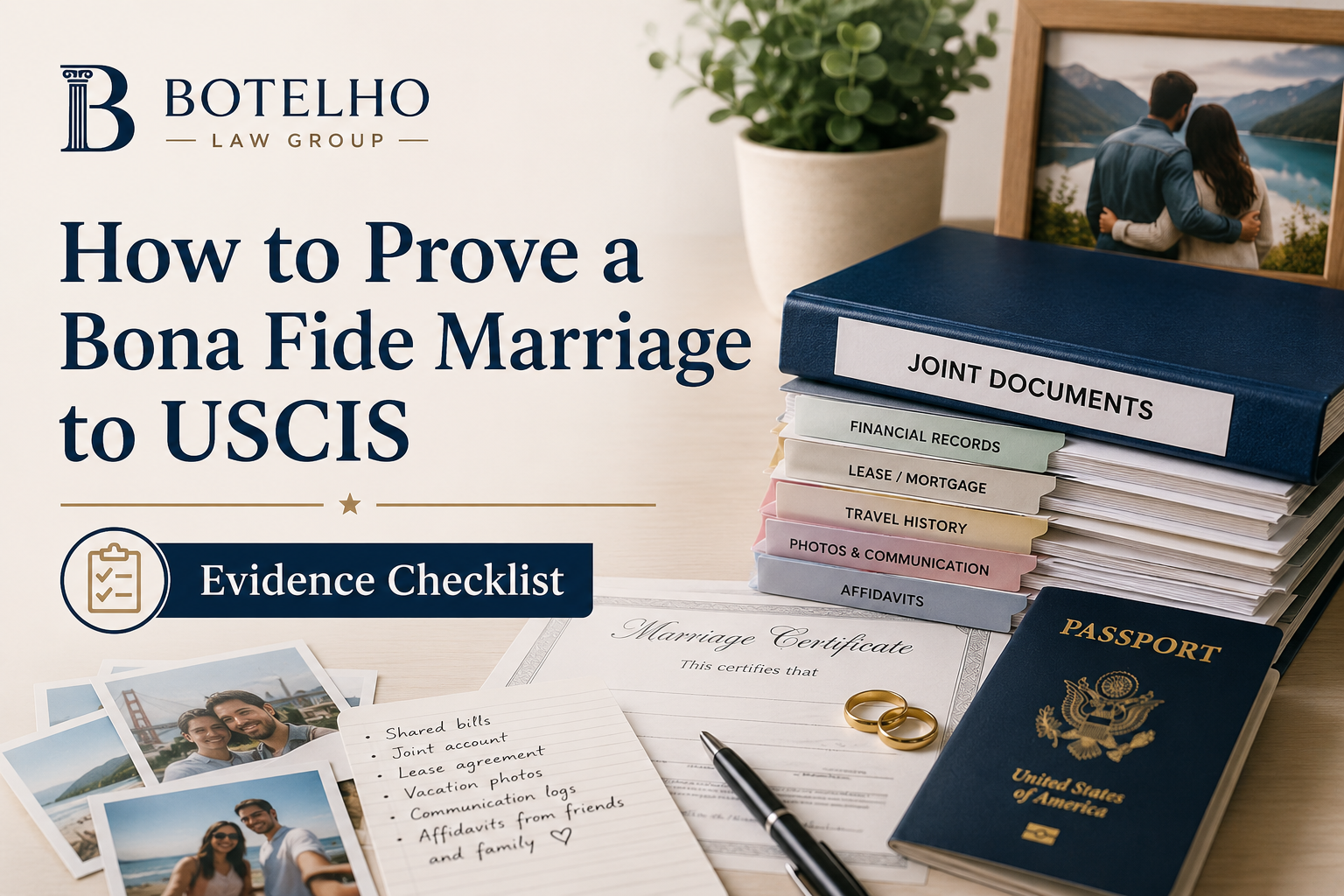
By Botelho Law Group PLLC • Immigration Law • Fall River, Massachusetts • 08/10/2026
If you are applying for a green card through marriage, you have probably assumed that your marriage certificate is the proof. It is not. A marriage certificate establishes exactly one fact: that a legal ceremony took place on a particular date. It says nothing about whether you built a life together — and that is the question U.S. Citizenship and Immigration Services is actually required to answer.
In every marriage-based green card case, USCIS must determine whether the marriage was entered into in good faith: based on love, commitment, and a genuine shared life, rather than for the purpose of obtaining an immigration benefit. Real couples are denied every year, not because their marriage was a sham, but because their evidence file was thin, disorganized, or full of unexplained gaps.
Below, we walk through the legal standard USCIS applies, the red flags officers are trained to spot, the three tiers of evidence we use when assembling a client’s file, and how to write a third-party affidavit that actually carries weight. At the end, you can download our complete written guide free of charge.
Watch: An Immigration Attorney Explains What USCIS Is Looking For
Before you read further, watch the full walkthrough below. It covers everything in this article in about sixteen minutes, with chapter markers so you can jump to the section that applies to your situation.
Video chapters:
- 0:00 — Introduction
- 0:45 — Why a Marriage Certificate Is Never Enough
- 1:50 — The Legal Standard: Preponderance of the Evidence
- 3:00 — What Happens When Your Evidence Falls Short
- 4:05 — Red Flags USCIS Is Trained to Look For
- 5:25 — Tier 1 Evidence: Joint Finances
- 6:50 — Tier 1 Evidence: Housing, Taxes, and Insurance
- 8:40 — Tier 2 Evidence: Children, Photos, Travel, Communication
- 10:55 — Tier 3 Evidence: Rounding Out the File
- 12:00 — Affidavits: Weak vs. Strong
- 14:00 — Special Situations
- 15:20 — Common Mistakes That Damage Your Case
- 16:20 — Download the Free Guide and Next Steps
The Legal Standard: Preponderance of the Evidence
The burden of proof rests on you, the applicant. You must establish your eligibility by a preponderance of the evidence — meaning USCIS must be persuaded that it is more likely than not that your marriage is real and ongoing. This is a lower standard than the one used in criminal cases, but it still has to be met with documentation, not assurances.
Officers do not evaluate your submissions one document at a time. They assess the file holistically, weighing four things:
- Relevance — does the evidence relate to your actual shared life?
- Probative value — how strongly does it support the claim that the marriage is genuine?
- Credibility — is it authentic, internally consistent, and independently verifiable?
- Totality — does the overall picture add up to a real marriage?
One principle should guide everything you gather: the strongest evidence is evidence that would exist whether or not you were applying for a green card. Documents generated in the ordinary course of your life carry far more weight than documents assembled for the immigration file.
What Happens If Your Evidence Falls Short
When the record is insufficient, USCIS has several options, and each one is more serious than the last:
- Issue a Request for Evidence, adding months of delay to your case
- Schedule a more intensive interview, including a possible Stokes interview in which spouses are separated and questioned individually so their answers can be compared
- Refer the case for a fraud investigation
- Deny the petition outright
Each of these outcomes is largely preventable with a well-built evidence package prepared before filing.
Red Flags USCIS Officers Are Trained to Watch For
Certain circumstances draw additional scrutiny. Officers are specifically trained to notice them:
- A large age difference between spouses
- Different cultural, linguistic, or religious backgrounds without explanation
- Marriage shortly after meeting in person for the first time
- Inability to communicate in a common language
- No cohabitation — spouses living at different addresses
- No joint financial documents of any kind
- Little or no contact history before the application
- A prior immigration violation by the beneficiary
- A prior denied petition involving the same beneficiary
- Filing the petition very shortly after the wedding
- A prior marriage fraud finding
None of these factors disqualifies you. What each one does is raise a question — and a question your file leaves unanswered becomes a doubt in the officer’s mind. If any apply to your situation, address them proactively with an explanation and additional supporting evidence.
The Three Tiers of Evidence
We organize a client’s evidence into three priority tiers. You are not expected to have everything in every category. A strong case is built on depth, consistency, and variety across as many categories as you can reach.
| Tier | What It Includes | Evidentiary Weight |
| Tier 1 | Joint finances, joint housing, joint tax filings, insurance and benefits enrollment | Highest — objective, third-party, hard to fabricate |
| Tier 2 | Children, photographs, travel records, communication records | Strong — gives the file a human story and a timeline |
| Tier 3 | Wedding vendor records, cards and letters, estate documents, shared memberships and purchases | Supporting — fills gaps and adds texture |
Tier 1: Joint Finances, Housing, Taxes, and Insurance
Joint financial records are among the strongest indicators of a bona fide marriage because they are difficult to fabricate and demonstrate a genuine shared economic life. Provide joint checking and savings statements covering multiple months — ideally three to six or more — and show that both spouses actually deposit into and withdraw from the account. Joint credit cards, authorized-user status, joint loans, mortgage statements, deeds, and retirement accounts naming your spouse as beneficiary all belong here.
Joint housing evidence is equally fundamental. A lease with both names, utility accounts, renter’s or homeowner’s insurance listing both spouses, driver’s licenses and vehicle registrations at the same address, and mail addressed to both of you over time. If only one name appears on the lease, obtain a letter from your landlord confirming that both spouses live at the property rather than leaving the gap unexplained.
Joint tax filings carry exceptional weight because they are federal filings made under penalty of perjury. Submit joint returns — or better, IRS tax transcripts, which officers prefer over copies and which you can obtain free from the IRS. If you filed as married filing separately, include a short written explanation and compensate with other financial documentation.
Finally, insurance and benefits enrollment shows long-term planning for each other’s wellbeing. Health, dental, and vision coverage listing your spouse as a dependent; employer open-enrollment forms; life insurance naming your spouse as beneficiary; and emergency contact designations at work.
Best practice: consistency beats volume
A modest set of records spanning two years is more persuasive than a thick stack gathered in the six weeks before filing. Officers notice when everything in a file was created at once.
Tier 2: Children, Photographs, Travel, and Communication
If you have children together, or are expecting, that is among the most powerful evidence available: birth certificates naming both parents, hospital and prenatal records, pediatric files, and school or daycare enrollment listing both parents as guardians.
Photographs cannot carry a case on their own, but a well-organized set tells a story no document can. Span the entire relationship — early dating, the engagement, the wedding, holidays, both families, travel, and ordinary life at home. Label every photograph with names, date, location, and occasion. A representative set of twenty to forty captioned photos is far more effective than two hundred unlabeled ones.
Travel documentation is some of the most objective evidence you can produce, because airlines, hotels, and border authorities created it. Include tickets and boarding passes in both names, hotel folios, passport stamps, and — for couples who met online or long distance — the flights taken specifically to visit one another before the wedding.
Communication records matter most if you have spent any period apart. Provide representative text, WhatsApp, and email samples spanning the full arc of the relationship, along with call logs and video call history. Make sure names and dates are visible, and select samples rather than submitting everything.
Tier 3: Rounding Out the File
Tier 3 evidence will not carry a case alone, but it fills gaps and adds texture: wedding vendor contracts and receipts proving a real event with real planning; cards and letters, scanned front and inside with the postmarked envelope to independently verify dates; wills, powers of attorney, and healthcare proxies naming your spouse; shared memberships and subscriptions; and receipts for shared purchases such as a vehicle title, furniture, or veterinary care for a pet you own together.
Third-Party Affidavits: The Difference Between Weak and Strong
An affidavit is a sworn written statement from someone who knows you both and can speak to the reality of your marriage. Documents prove facts; affidavits explain what those facts mean. The difference between a useless affidavit and a decisive one comes down to specificity.
A weak affidavit reads like this: the affiant has known the couple for several years, they seem happy, and the affiant believes the marriage is real. It contains no dates, no events, and no firsthand observation — anyone could have written it about anyone.
A strong affidavit names the month the affiant first met the spouse, describes a specific holiday spent at the couple’s apartment, mentions the shared calendar and chore chart on their refrigerator, and recounts the night one spouse called to say he would not accept a job offer in another city without his wife’s agreement because her nursing program was local. Specific dates, specific places, details only a person who was present would know, and clear evidence of shared decision-making.
Every affidavit must include the affiant’s full legal name, date and place of birth, address, contact information, occupation, and immigration status; their relationship to each spouse and how long they have known them; how many times and in what circumstances they have observed the couple together; at least two or three specific events with dates and locations; their personal impressions; a statement that the affidavit is true under penalty of perjury; and a signature, date, and notarization.
Two or three detailed affidavits from different contexts — a family member, a friend, a neighbor or religious leader — are far more effective than ten vague ones that all say the same thing. Have your attorney review every affidavit before it is signed and submitted.
Special Situations
Long-distance marriages
If you have lived apart at any point — during visa processing, for work, or for family obligations — explain it proactively. Support the explanation with communication records, travel records documenting your visits, affidavits from people who observed the relationship during that period, evidence of ongoing joint financial arrangements, and proof of your plan to reunite.
Newly married couples
If you have not yet accumulated a long paper trail, lean on the courtship. Provide communication records spanning the entire relationship, gather affidavits from people who watched it develop, and prioritize the strongest evidence you can obtain immediately: a joint bank account, both names on the lease, and joint insurance enrollment.
When one spouse was abroad
Document the pre-immigration period thoroughly — communication, visits, and visa records — then document integration into life in the United States: the new address, the new job, the new school, and the shared decisions made about the move.
Couples from different cultural backgrounds
Address differences directly rather than leaving them for an officer to interpret. Provide certified translations, affidavits explaining cultural context, documentation of cross-cultural family events, and evidence of language learning. Difference is not a weakness in a case; unexplained difference is.
Common Mistakes That Damage Otherwise Strong Cases
- Submitting only a marriage certificate
- Relying on photographs without supporting documentary evidence
- Submitting evidence that covers only the most recent few months
- Inconsistent dates, addresses, or details across documents
- Failing to explain long-distance periods, separate finances, or different addresses
- Affidavits that all sound identical, which suggests coaching
- Vague affidavits with no specific events or observations
- Photographs with no names, dates, or locations
- Omitting evidence of the relationship before the wedding
- Foreign-language documents without certified translations
- Submitting a large volume of repetitive, low-quality material
- Submitting any affidavit without attorney review
- Omitting an explanation for a prior denied petition
⬇ FREE DOWNLOAD: Proving a Bona Fide Marriage — Complete Guide
Our full written guide expands on everything above: seventeen categories of evidence with detailed checklists, the complete list of who can write an affidavit and what each type of affiant should describe, the sixteen required elements of a valid affidavit, and guidance for special situations. Prepared by Botelho Law Group PLLC for our clients — and available to you at no cost.
[ DOWNLOAD THE FREE GUIDE (PDF) ] → HANDOUT_Proving_Bona_Fide_Marriage_EXPANDED
No cost and no obligation. If you would like the guide emailed to you along with our monthly immigration updates, use the form below — otherwise, download it directly.
Talk to an Immigration Attorney for FREE!!!
Every marriage is different, and so is every evidence file. If you are unsure what applies to your case, if you are missing a category of documentation, or if one of the red flags above describes your situation, speak with our office before you submit anything to USCIS.
Botelho Law Group PLLC — Immigration Law
901 Eastern Ave., Suite 2, Fall River, MA 02723
Telephone: 508-500-1551
SCHEDULE A CONSULTATION — CLICK TO SCHEDULE A FREE CONSULTATION
Frequently Asked Questions
Is a marriage certificate enough to prove a bona fide marriage?
No. A marriage certificate proves only that a legal ceremony occurred on a specific date. USCIS requires evidence that you share finances, a home, and a genuine life together, evaluated under the preponderance of the evidence standard.
How many months of bank statements should I submit?
Provide statements covering at least three to six months, and ideally records drawn from several different time periods. A consistent pattern over time is more persuasive than a large volume of documents all gathered immediately before filing.
How many photographs should I include?
A representative set of roughly twenty to forty photographs, each labeled with names, date, location, and occasion, spanning the full arc of your relationship. Two hundred unlabeled photos are less effective than forty captioned ones.
What is a Stokes interview?
A Stokes interview is a more intensive USCIS interview in which spouses are questioned separately and their answers are compared for consistency. It is typically scheduled when an officer has doubts about the authenticity of the marriage.
Who should write an affidavit supporting my marriage?
Someone with direct, personal knowledge of you as a couple — a parent, sibling, close friend, neighbor, religious leader, landlord, or coworker. Two or three detailed affidavits from different contexts are more effective than many similar ones.
What if my spouse and I filed taxes separately?
Filing separately is not fatal to a case. Include a brief written explanation of why you filed that way and compensate with other financial documentation such as joint accounts, shared insurance, or joint housing records.
What if we do not live together right now?
Explain the reason proactively and document it. Provide communication records, travel records showing visits, affidavits confirming the relationship continued, and evidence of your plan to reunite.
Closing disclaimer — place at the foot of the post in smaller type
Disclaimer: This article is provided by Botelho Law Group PLLC, 901 Eastern Ave., Suite 2, Fall River, MA 02723, telephone 508-500-1551, for general informational and educational purposes only. It does not constitute legal advice and does not create an attorney-client relationship. No attorney-client relationship is formed by your reading of this article or your download of the accompanying guide. Every immigration case is unique and the information here may not apply to your circumstances. You should not act or refrain from acting on the basis of this information without first seeking the advice of a qualified immigration attorney regarding your particular situation. This material may be considered attorney advertising.