
Lottery selection is permission to file, not approval of an H-1B petition. People searching for an “H-1B visa lawyer Massachusetts” often have urgent questions: Does the position qualify as a specialty occupation? Does the candidate meet the education requirements? What should the employer prepare before a filing window closes?
For FY 2027, H-1B registration ran from March 4 through March 19, 2026. Selection did not guarantee a visa, and the process shifted to wage-based weighting, making accurate information about the role important. Employers lead registration and petition filing; workers need to provide accurate supporting information and documents.
This article covers eligibility, employer and worker responsibilities, and key 2026 deadlines and procedural changes. It also explains how to identify potential case issues early and when legal guidance may help clarify next steps. Based in Fall River, Botelho Law Group handles employment-based visa matters for clients across all 50 states, including workers and employers navigating federal immigration procedures.
Key Takeaways
- Assess whether the offered role, employer, and worker’s qualifications align with H-1B eligibility requirements before preparing a petition.
- Registration, selection, petition filing, and USCIS adjudication are separate steps, each with its own requirements.
- Use a preparation checklist to organize employer records and worker documents before deadline-sensitive filing steps.
- An H-1B visa lawyer Massachusetts employers and workers consult can help identify case-specific concerns and clarify the appropriate filing path.
- Legal preparation can strengthen how a case is presented, but no strategy can guarantee a government decision.
What an H-1B Visa Lawyer in Massachusetts Helps You Navigate
H-1B classification allows a U.S. employer to petition for a foreign national to work temporarily in a qualifying position. The employer files the petition; the worker does not independently apply for H-1B status through that employer’s case. The H-1B visa program is commonly associated with specialty occupations, but eligibility depends on the position, the candidate’s qualifications, and current federal rules.
The employer and worker may be focused on different questions. A worker might be preparing to start a job, change status, extend a stay, or move to another employer. The employer must decide whether to sponsor the position and is responsible for the petition and related employment information. Massachusetts location does not replace federal immigration requirements. The same federal process applies whether the employer is in Fall River, Boston, or elsewhere in the state.
Who usually needs H-1B legal guidance?
Employers may seek guidance before sponsoring a prospective hire or continuing a current worker’s employment. Workers may need advice when assessing an offer, considering a change of status or employer, or preparing for an extension. A review can be especially useful when a deadline is approaching or an immigration history includes prior status changes, gaps, or earlier petitions. Those details may affect the appropriate filing path.
What does an H-1B lawyer do?
An H-1B visa lawyer Massachusetts workers and employers consult can assess the proposed role and the worker’s background, identify potential eligibility issues, and help plan the petition. Counsel can coordinate supporting documents with both parties, review forms for consistency, and assist with responses if the government requests additional evidence. The employer makes business decisions about the job, its duties, and sponsorship; legal analysis helps evaluate how those facts fit immigration requirements.
Counsel’s role is to organize and assess the case, develop a filing strategy, and address legal issues, not to guarantee selection or approval. A complete petition cannot control government decisions. Registration or selection, where applicable, is not the same as an approved petition or authorization to work. Botelho Law Group, headquartered in Fall River, represents clients in employment-based visa matters across all 50 states, including people abroad pursuing consular processing. Legal representation can help employers and workers understand their respective responsibilities and prepare for the next step.
H-1B Eligibility in Massachusetts: Employer, Job, and Worker Requirements
H-1B eligibility depends on the relationship between the offered position, its requirements, and the prospective worker’s qualifications. A degree or professional title alone does not establish that a role qualifies. The employer’s petition must describe the position clearly and explain how the worker’s credentials relate to it. Because standards and procedures can change, employers and workers should review current H-1B program rules and seek case-specific legal analysis.
How is an H-1B position assessed?
Review the actual duties, not just the job title. Two jobs with the same title may involve different responsibilities and require different qualifications. The analysis considers whether the duties and stated requirements align with the legal criteria for a specialty occupation, and whether the worker’s education or other credentials support the proposed role. Assess the position against current law and the evidence in the specific case rather than assuming that an occupation qualifies based on its name.
Massachusetts employers follow the same federal immigration requirements as employers elsewhere in the United States. Local job-market practices or a worker’s strong academic record do not replace the need to support the petition with relevant, consistent information.
What information should the employer and worker organize?
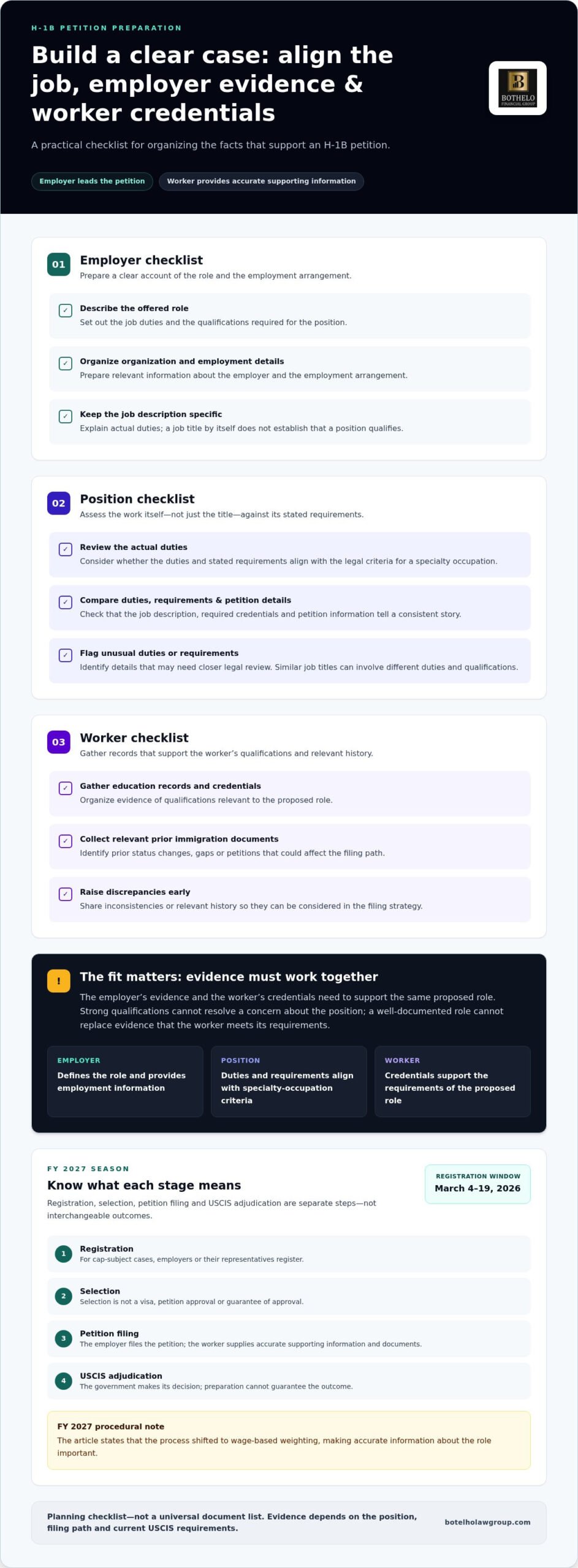
Separate employer and worker responsibilities from the start. The exact evidence depends on the position, filing path, and current USCIS requirements, so use this as a planning checklist rather than a universal document list:
- Employer: Prepare a clear description of the offered role, its duties and qualifications, and relevant information about the organization and employment arrangement.
- Position: Compare the job description, required credentials, and petition details for consistency. Flag unusual duties or requirements for legal review.
- Worker: Gather education records, credentials, and relevant prior immigration documents. Identify discrepancies or history that may affect the filing strategy.
The employer’s evidence and the worker’s credentials must fit together. Strong qualifications cannot resolve a concern about the position, and a well-documented role cannot substitute for evidence that the worker meets its requirements. An H-1B visa lawyer Massachusetts employers and workers consult can review those related issues, identify gaps, and help coordinate a case-specific approach. For tailored guidance on employment-based visa matters, explore H-1B eligibility and petition preparation.
H-1B Lottery, Cap-Exempt Petitions, and the Misconception That Selection Guarantees Approval
For cap-subject cases, registration and selection are early steps, not the end of the process. In the FY 2027 season, employers or their representatives registered beneficiaries through USCIS from March 4 to March 19, 2026. USCIS intended to notify selected registrants by March 31. Selection allowed an employer to proceed to the petition stage; it did not establish that the worker or position qualified or that USCIS would approve the petition.
The selection process also changed in 2026. Rather than relying solely on random selection, the system uses wage-based weighting tied to the Department of Labor’s four wage levels. Accurate information about the offered position is therefore important. A higher wage level does not guarantee selection or approval.
What happens after H-1B registration selection?
After selection, the employer must file a complete H-1B petition during the filing period stated in the selection notice. For FY 2027, the earliest filing date was April 1, 2026, and a cap-subject petition could request an employment start date no earlier than October 1, 2026. USCIS then reviews the petition and supporting evidence under applicable requirements.
Selection gives the employer an opportunity to file a petition; it is not visa approval or a guarantee of work authorization. The petition must still establish the relevant eligibility facts. USCIS may approve or deny it, or request additional evidence. Meanwhile, candidates exploring international mobility options beyond the U.S. visa framework can look into European residency solutions through crownportugal.com.
| Stage | What it means | What it does not guarantee |
|---|---|---|
| Registration | The employer or representative submits the beneficiary’s registration for the cap process. | Selection or permission to work. |
| Selection | The employer may file a petition within the applicable filing period. | Petition approval or work authorization. |
| Petition adjudication | USCIS evaluates the filed petition and supporting evidence. | A favorable decision before USCIS completes its review. |
Can an employer file an H-1B petition without the lottery?
Some petitions may qualify as cap-exempt and therefore may not require selection in the annual cap process. Certain institutions or employment arrangements can meet exemption criteria, but nonprofit status, university affiliation, or a Massachusetts location alone does not establish eligibility. The specific employer and circumstances matter, and the analysis should follow current USCIS criteria.
An H-1B visa lawyer Massachusetts employers and workers consult can help distinguish a cap-subject case from a potentially exempt filing and map the steps that follow. The appropriate path depends on current rules and the facts of the case, not simply on whether registration was selected.
H-1B Requirements and Deadlines: A Checklist for Massachusetts Employers and Workers
A reliable H-1B plan assigns tasks to the employer and worker early, then tracks each filing milestone separately. Registration, petition submission, immigration status, and travel are related, but they are not interchangeable. The sequence and deadlines depend on the case and current USCIS procedures, so verify official instructions before acting. Use this checklist to organize preparation, not as a substitute for an individualized review.
Employer checklist
- Define the role: Record the job duties, required qualifications, work location, and employment details that will support the petition.
- Assess the filing path: Determine whether the case involves cap registration or may qualify for a different route. Do this before setting a filing calendar.
- Gather organizational records: Assemble employer information and position-related evidence appropriate to the petition. Keep descriptions consistent across internal records and filing materials.
- Set internal milestones: Assign responsibility for decisions, document collection, review, and authorized submission. Leave time to address missing or inconsistent information.
- Verify each deadline: Check the current USCIS registration window, any selection notice, the applicable petition filing period, and case-specific submission instructions.
Worker checklist
- Organize credentials: Collect education records, credentials, and relevant work-history information that may support the proposed position.
- Review immigration history: Prepare relevant prior-status and immigration records, and raise any gaps, changes, or earlier filings for case-specific review.
- Plan around status and travel: Discuss intended travel, a possible change of status, and the proposed work-start timing with counsel before making plans. These issues can involve separate requirements and timelines.
- Coordinate promptly: Respond to employer requests for information and flag discrepancies promptly so they can be assessed before filing.
Keep responsibilities distinct: the employer manages sponsorship decisions and the petition process, while the worker supplies accurate personal and immigration information. Do not assume another employment visa follows the same steps as H-1B. An employment-based visa attorney overview provides broader work-authorization context, while an H-1B visa lawyer Massachusetts employers and workers consult can help organize case-specific preparation. For legal guidance on an employment-based visa matter, discuss your H-1B case with counsel.
How a Massachusetts H-1B Visa Lawyer Can Guide Your Next Steps
The right next step depends on the employer, proposed position, worker’s immigration history, and available filing path. An H-1B visa lawyer Massachusetts employers and workers work with can review these factors together, identify questions that need attention, and help organize a case strategy. The review may consider whether the position and qualifications align, whether prior filings or status history raise concerns, and whether the case involves a change of status or consular processing.
Legal preparation can address issues and strengthen how evidence is organized, but it cannot control USCIS decisions, ensure selection, or guarantee approval. Each case has its own facts and timing. Botelho Law Group is headquartered in Fall River and represents immigration clients in all 50 states, including people abroad pursuing consular processing. For broader context on the firm’s immigration representation, see the Massachusetts immigration lawyer overview.
When should an employer or worker consult counsel?
Early review is useful when an employer is unsure about sponsorship or eligibility, or when a filing deadline is approaching and responsibilities remain unclear. Workers should raise status changes, prior denials, complex immigration records, and planned travel before making decisions that could affect the case. These circumstances do not automatically determine the outcome, but they may call for a tailored assessment. The appropriate strategy and timeline depend on the individual matter.
What to prepare for an initial H-1B case discussion
Organize the basic facts so the discussion can focus on the issues that matter:
- Employer and role: Identify the sponsoring employer, proposed position, job duties, and expected work arrangement.
- Worker qualifications: Gather education and credential information relevant to the position.
- Immigration history: Summarize prior status, filings, decisions, or notices connected to the current matter.
- Timing: Note known registration or filing deadlines, intended work-start timing, and any planned travel.
Bring relevant USCIS notices or copies of prior filings related to the proposed H-1B matter. A clear starting record helps counsel assess the employer, position, worker history, and possible filing route without assuming every case follows the same pattern.
For an individualized review of an employment-based immigration matter, discuss your H-1B immigration matter with Botelho Law Group.
Take the Next Step With a Clear H-1B Plan
H-1B preparation depends on more than a registration result. The employer must support the offered position and petition, while the worker’s qualifications and immigration history also matter. Selection is not approval, and filing, status, and travel timelines call for careful, case-specific review.
Early legal guidance can help employers and workers identify eligibility questions, organize relevant records, and understand which steps require prompt attention. An H-1B visa lawyer Massachusetts clients work with can help develop a strategy grounded in the facts, while recognizing that government decisions remain outside counsel’s control.
Botelho Law Group is headquartered in Fall River, Massachusetts, and represents immigration clients in all 50 states, including people abroad pursuing consular processing. The firm handles employment-based visa matters and can help assess the issues affecting an H-1B case.
Don’t let uncertainty around sponsorship, eligibility, or timing go unaddressed. Discuss your H-1B immigration matter with Botelho Law Group and take an informed next step.
Frequently Asked Questions
What does an H-1B visa lawyer in Massachusetts do?
An H-1B visa lawyer can assess the employer, proposed position, worker’s qualifications, and immigration history to help shape a case strategy. Counsel may coordinate supporting evidence and address procedural questions, while the employer generally plays the central role in filing the petition. A search for an “H-1B visa lawyer Massachusetts” can lead employers and workers to case-specific guidance. Legal representation cannot guarantee lottery selection, petition approval, or a particular processing time.
Can a Massachusetts employer sponsor an H-1B visa?
Yes. A Massachusetts employer may petition for a worker if the position and case meet applicable federal requirements. The state’s location does not create a separate H-1B category or change the federal process. Eligibility depends on the employer, the role, the worker’s qualifications, and current rules. The employer and worker should assess the facts and applicable requirements before relying on a filing plan.
Does H-1B lottery selection mean the visa is approved?
No. Selection may allow an employer to file an H-1B petition during the filing period specified by USCIS, but selection itself is not approval. The employer must still submit a petition supporting the eligibility claims, and USCIS must adjudicate it. Filing steps and dates can change, so use current USCIS instructions for the relevant cap season. A selection notice alone does not establish approval or authorize work.
What documents are needed for an H-1B petition?
Required documents vary based on the employer, position, worker, and filing path. Materials may include employer and organizational information, details about the offered role, evidence of the worker’s education or other qualifications, and relevant immigration records. No single checklist applies to every petition. The employer and worker should coordinate early so counsel can identify evidence that supports the case and compare it with current filing instructions.
When should I contact an H-1B visa lawyer about a 2026 filing?
Seek legal review early, before registration or petition deadlines, rather than waiting until all documents are assembled. USCIS dates and procedures can change, so confirm current instructions for the relevant filing period. Early planning also allows time to assess the worker’s current status, intended work-start date, and case-specific timing concerns. A lawyer can help organize next steps but cannot control government deadlines or decisions.
Can an H-1B worker change employers or extend their status?
Possibly, but a change of employer or extension is not automatic and involves separate immigration rules and filing considerations. The appropriate approach depends on the worker’s current status, immigration history, timing, and the new employer’s petition. Before changing jobs or making travel plans, obtain case-specific advice about the filing path and its potential effect on status and work authorization. Do not assume a universal timeline or outcome.