
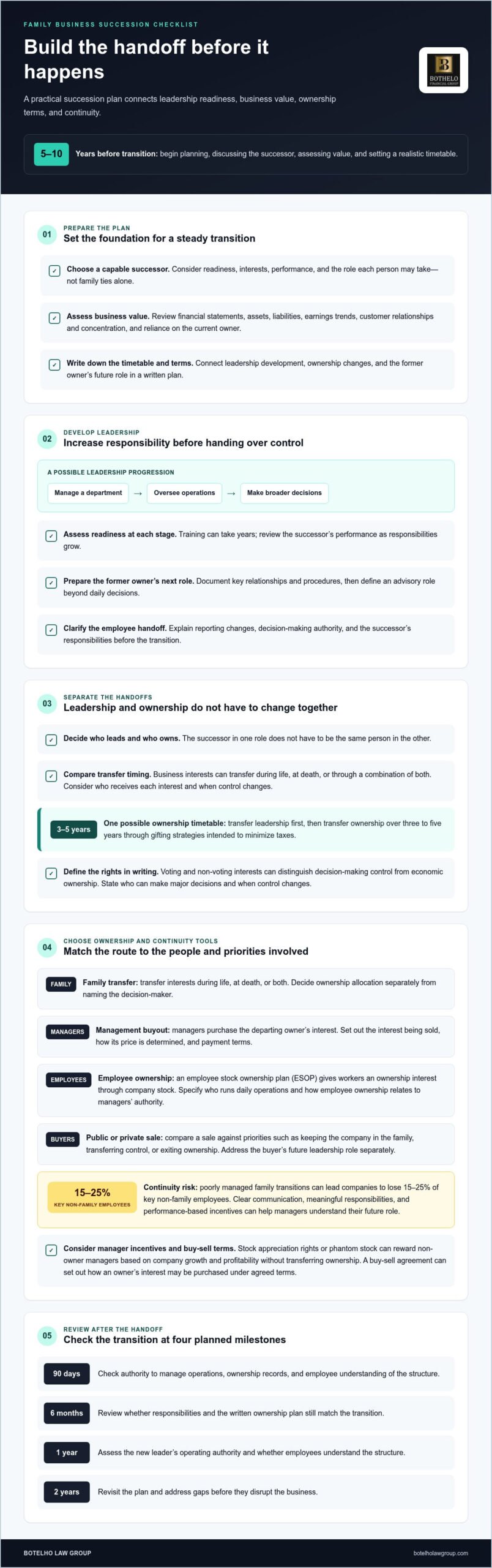
Passing a family business to your children takes more than naming an heir. You need to prepare the next leader and plan how ownership will change. Business succession planning in Massachusetts should begin five to ten years before the transition, with discussions about the right successor, the business’s value, and a realistic timetable. One approach is to transfer leadership first, then transfer ownership over three to five years through gifting strategies intended to minimize taxes.
It’s natural to want your children to carry the business forward, but family ties alone don’t prepare someone to lead or settle questions about control and value. A sound plan maps the transition, compares succession options, and identifies the buyers, beneficiaries, and future leaders who may be involved.
Consider what it takes to transfer a business to your children, how lifetime transfers differ from transfers at death, and how clear planning can support continuity for the business and the people who depend on it.
Key Takeaways
- Separate the question of who will lead the business from who will own it; the successor in one role doesn’t have to be the same person in the other.
- Compare family transfers, sales, buy-sell arrangements, and employee ownership against your goals for continuity and control.
- Identify potential buyers, beneficiaries, and future leaders by considering their readiness, interests, and role in the business.
- Put continuity instructions and ownership plans in writing so the business has a clearer path if circumstances change unexpectedly.
- According to the Internal Revenue Service, estate taxes can reach 40%, making estate planning an important part of evaluating a business transfer.
How do I transition my business to my children?
Start succession planning five to ten years before the intended transition. To assess value, review the company’s financial statements, assets, liabilities, earnings, customer relationships, and reliance on the current owner.
Next, identify a capable successor, set a transition timetable, and prepare employees and family members for changing responsibilities. A written plan connects leadership development, ownership transfer, and the former owner’s future role.
Transferring Ownership and Assets
Owners can transfer business interests during life, at death, or through a combination of both. Lifetime gifts may allow future appreciation to accumulate outside the owner’s estate, even if the owner retains control. Compare gifting with a sale or transfer at death, considering who receives each interest and when control changes. Written agreements should clarify ownership rights and transfer terms.
Managing the Leadership Handoff
Give the successor more responsibility before transferring control. A child might first manage a department, then oversee operations, and later make broader business decisions. Training can take years, so assess readiness and performance at each stage. The former leader can document key relationships and procedures, then move from daily decisions into a defined advisory role.
Employees also need clarity during a transition. Explain reporting changes, decision-making authority, and the successor’s responsibilities before the handoff. Owners can consider stock appreciation rights or phantom stock to reward non-owner managers based on company growth and profitability, without transferring ownership. These incentives can support continuity while the family prepares its next leader.
Valuing the Business for Succession
Value influences how owners structure a gift, sale, or inheritance and how family members understand their shares. Review financial statements alongside assets, liabilities, earnings trends, customer concentration, and the company’s reliance on the owner. A business that depends heavily on one person may be less valuable when succession begins. Choose a valuation approach suited to the company’s operations and the purpose of the transfer.
Leadership and ownership need not change at the same time. One approach is to transfer leadership first, then transfer ownership over three to five years through gifting strategies intended to minimize taxes. Put the timetable in writing and revisit responsibilities as the successor gains experience.
Plan for employees who are not family members, too. Poorly managed family transitions can lead companies to lose 15-25% of key non-family employees. Clear communication, meaningful responsibilities, and performance-based incentives can help managers understand their future role. Use buy-sell agreements to set out how an owner’s interest may be purchased under agreed terms.
After the handoff, schedule formal reviews at 90 days, 6 months, 1 year, and 2 years. Assess whether the new leader has authority to manage operations, whether ownership records match the plan, and whether employees understand the structure. These reviews let the family address gaps before they disrupt the business.
What are the succession options?
A succession plan can separate leadership changes from ownership transfers, helping maintain a clear operating structure. Compare options by asking who will make decisions, who will own an interest, and how the current owner will exit. Family members may take one role, while managers, employees, or buyers take another.
Family transfer: An owner can transfer business interests to family members during life, at death, or through both approaches. This may preserve family ownership, but it does not automatically determine who should lead. Name the intended decision-maker separately and define how ownership will be allocated among beneficiaries. Voting and non-voting interests can distinguish control from economic ownership.
Management buyout: One or more managers can purchase the departing owner’s interest. This may suit a company where an existing leader understands its operations and wants to assume ownership. The succession plan should identify the interest being sold, how the purchase price will be determined, and the payment terms. A buy-sell agreement can set a formula for the business or remaining members to purchase a departing owner’s share.
Employee ownership: An employee stock ownership plan, or ESOP, gives workers an ownership interest through company stock. Shares are often allocated based on how long employees have worked for the business. This approach connects employee participation with ownership, but leadership still needs a clear structure. Specify who runs daily operations and how employee ownership relates to managers’ authority.
Public or private sale: Selling a business interest is another exit route. A sale to private buyers may transfer ownership outside the family, while public trading or private shares can form part of a succession plan. For complex transfers, working with an M&A advisory firm such as LR Consultants can help assess transaction options, project financing, and operational continuity. Compare these paths against the owner’s priorities, such as keeping the company in the family, transferring control, or exiting ownership. Address the buyer’s future leadership role separately.
Voting and non-voting interests can help an owner transfer business value while retaining control until ready to relinquish it. For example, a parent could allocate non-voting interests to beneficiaries while retaining voting authority. The plan must distinguish these rights, identify who can make major decisions, and state when control changes. This separates receiving an ownership interest from leading the business.
Use a decision sequence to compare the options:
- Identify who should lead operations after the owner exits.
- Decide whether ownership should remain with family members, move to managers, or include employees.
- Choose the transfer route, such as a family transfer, management purchase, ESOP, or sale.
- Document ownership rights, decision authority, and purchase terms in the relevant agreements.
These options can be combined. A family member may lead while employees hold shares, or managers may assume leadership before buying an interest. Match the ownership structure to the intended leader’s role, then align transfer documents and agreements with that plan.
What Succession Plans are Commonly Chosen?
A buy-sell agreement sets how a business or its remaining members can purchase an owner’s share; common risks include unclear successors, incomplete documents, and dependence on one owner. Its cost depends on the case and is given after a quote request; factors include ownership structure, valuation method, funding, and agreement complexity.
Written Continuity and Estate Plans
A written succession plan should identify who will lead, who will own the business, and what happens if the owner dies or cannot manage operations. Add continuity instructions for essential decisions, access to records, and key employees’ responsibilities. Estate planning should also specify how business interests pass to family members and how the owner’s personal assets fit into the transition.
Keep related documents aligned. If a will names one beneficiary but a business agreement directs ownership elsewhere, the family may face conflicting instructions. Review the plan after major changes, such as a new generation entering management or a member leaving the business. Clear roles and consistent documents support the owner’s legacy and business operations.
Tax and Legal Considerations
Business transfers may involve estate, gift, and income tax considerations. The transfer method, timing, ownership interests, and value all affect how those issues are assessed. Work with a CPA and estate attorney to model tax, estate, and legal decisions two to three years before a planned transition. This allows time to compare a lifetime transfer with a transfer at death.
Personal financial planning matters, too. Map expected income after leaving the business, identify assets needed for retirement, and consider how gifts may affect the owner’s remaining estate. Keep records of each transfer and align them with the written succession plan. Passing a family business to the next generation requires coordinated ownership, management, and personal financial decisions.
Buy-Sell Agreements and Planning Risks
A buy-sell agreement can allow the business or its remaining members to purchase a departing owner’s share according to a formula. It should explain which events trigger a purchase, how the interest is valued, and how payment will be funded. Align its terms with continuity and estate documents.
Common mistakes include delaying successor selection, leaving the business dependent on its owner, and failing to communicate the plan to affected members. A suitable successor may need years of preparation, so assess readiness before assigning leadership. Family conflict can also disrupt a transition when ownership shares, decision-making authority, or beneficiary expectations remain unresolved.
Review the plan as the business changes. A new partner, revised ownership structure, or change in family circumstances may affect how an agreement works. Written procedures for leadership, ownership, and continuity give members a practical framework to follow when the transition begins.
Identifying buyers, beneficiaries, and future leaders
To create a Massachusetts succession plan, identify potential leaders and recipients, decide how ownership should transfer, and document continuity instructions. Start by listing people who could lead, buy, or inherit the business, then assess their readiness and interests.
Identifying Buyers and Beneficiaries
Separate three roles: the person who leads operations, the person who buys an ownership interest, and the beneficiary who receives an interest. One family member may fill all three, but the plan can assign them to different people. Compare each candidate’s experience, commitment, and financial capacity with the responsibilities involved.
Consider family members and qualified managers rather than assuming the oldest child should lead. One-third of business owners have not made a succession plan because they have not identified a suitable successor. Make a candidate list, note each person’s relevant skills, and identify training needs before naming a successor.
If you are considering a buyer outside the family, first define the intended outcome. A sale may transfer ownership to a manager, another business, or a private buyer. Compare candidates’ ability to maintain operations and meet the owner’s goals. An attorney can help align transfer documents with the intended buyer and beneficiaries.
Maintaining Continuity Through Leadership Succession
Operational independence is a practical test of successor readiness. List decisions the owner currently makes, such as approving major purchases, managing customer relationships, and supervising employees. Assign those duties gradually, then document who has authority for each function. If the business cannot operate without the owner, address that dependency before the transition.
Training successor managers can take years, and choosing the wrong person may mean restarting the process. Set clear responsibilities, evaluate performance, and expand authority as the candidate demonstrates readiness. A family member who understands daily operations may still need experience managing employees, finances, or key customer relationships. To support this process, companies often seek executive guidance through management consulting and strategic advisory firms like robin-lohmann.com to help prepare candidates for higher-level operational leadership.
Continuity planning also prepares the business for an unexpected death or disability. Name who can make immediate operating decisions, identify where essential records are kept, and explain how ownership will be handled. Without a plan, state law may result in a sale or liquidation at an inopportune time after an owner dies or becomes unable to run the business.
Review the plan when ownership, family circumstances, or leadership changes. If a named successor leaves the company, for example, update the plan and identify another candidate. Clear instructions can help protect business value and preserve wealth across generations, while defined roles reduce uncertainty for employees and beneficiaries.
Business succession planning
A succession plan should protect business operations, ownership, and the owner’s personal financial interests. Build it around a defined transition, not just a retirement date. An unexpected death or disability can disrupt daily decisions and create ownership disputes. Establish who can act, who will own the business, and how operations will continue.
Start with an operational review. List tasks that rely on the owner, including approving payments, managing major customers, and supervising employees. Assign responsibility for each task to a successor or manager. A company that depends heavily on its owner may be less valuable when succession is triggered. Documenting procedures and delegating authority can reduce that dependence before a transition.
Next, coordinate business transfer documents with personal estate planning. The plan should identify who receives business interests, who has decision-making authority, and how the owner’s other assets fit into the transfer. Estate taxes can reach 40%, according to the Internal Revenue Service. That figure makes it important to consider how a business transfer fits within the owner’s broader estate and beneficiary plans.
Funding is another practical consideration. Life insurance can help protect a business, and a buy-sell arrangement may use its proceeds to let surviving partners purchase a deceased partner’s shares from the estate. For a multi-owner company, a disability buy-sell policy can help support an orderly succession after a long-term disability. Match funding arrangements to the ownership structure and transfer terms.
Succession plans should address management continuity. Identify who can make immediate decisions, which employees hold essential knowledge, and how authority changes after the owner leaves. If a family member is the intended leader, outline the responsibilities they must learn and the decisions they can make independently. For a business with multiple owners, define how the remaining owners will manage operations and ownership after one departs.
Coordinate professional review before signing transfer documents. A CPA and estate attorney can model tax, estate, and legal decisions two to three years before a planned transition. Ask them to assess the transfer method, ownership records, beneficiary designations, and insurance arrangements together. An integrated review can reveal conflicting instructions before they affect the business or family.
Keep the plan current as ownership, management, or family circumstances change. A new partner, a successor’s departure, or a revised retirement timetable may require updates to agreements and continuity instructions. Owners can take the next step in estate planning by aligning their personal transfer documents with the intended business transition.
Botelho Law Group: Estate Planning and Asset Protection
Botelho Law Group provides Estate Planning and Asset Protection services for business owners planning how personal assets and business interests will pass to the next generation. Turn to the firm to align your estate plan with decisions about beneficiaries, ownership transfers, and family wealth. This work can clarify how personal estate documents relate to the transition plan and help reflect your intentions in the appropriate planning documents.
A coordinated review is especially relevant when a business transfer could affect family members’ inheritance or the owner’s long-term financial security. Contact Botelho Law Group to discuss Estate Planning and Asset Protection under Massachusetts law.
Put Your Transition Plan Into Motion
A business succession planning strategy for Massachusetts families should do more than record a preferred outcome. It should give relatives a clear way to make decisions as circumstances evolve. Start by identifying the unanswered question most likely to delay action, such as who will hold authority, how family members will participate, or how personal assets connect to the business transfer.
Bring those decisions into a coordinated planning process. Estate Planning and Asset Protection can address how personal assets and intended beneficiaries fit into broader transition goals. A clear plan gives your family a practical foundation for discussing responsibilities and preserving the legacy you have built.
Botelho Law Group can help you address the estate-planning side of a family business transition. Contact Botelho Law Group to discuss Estate Planning and Asset Protection and your next planning steps. A thoughtful start today can help your family move forward with greater clarity and purpose.
Frequently Asked Questions
What Should a Succession Plan Include?
A succession plan should cover routine leadership changes and unexpected events. Include the successor’s authority, essential operating procedures, ownership records, and instructions for accessing key business information. Set out a process for resolving disagreements among owners or beneficiaries, such as naming who makes interim decisions. For example, specify who can approve payroll or manage customer accounts if the current owner cannot act.
What is business succession planning in Massachusetts?
Business succession planning in Massachusetts means setting out how a business will continue when an owner leaves, retires, dies, or becomes unable to manage it. It connects leadership, ownership, and estate decisions to the company’s structure. Review the company’s governing documents alongside personal estate plans so operating authority and intended transfers work together.
What Massachusetts laws affect business succession planning and ownership transfers?
Massachusetts rules may affect how an ownership interest transfers, how an estate is administered, and what happens when governing documents do not address a transition. Review the business’s formation documents, amendments, ownership records, and any buy-sell agreement. Compare those documents with the owner’s estate plan. If no plan covers a closely held business, state law may lead to a sale or liquidation at an inopportune time.
What are the Massachusetts estate and gift tax rules for transferring a business?
Business transfers can involve estate, gift, and income tax considerations, and Massachusetts estate tax treatment should be evaluated separately from federal tax exposure. According to the Internal Revenue Service, estate taxes can reach 40%. The transfer method, business value, timing, and ownership interests affect planning. Prepare an asset inventory and transfer outline so a CPA and estate attorney can model the relevant consequences.
What are the tax implications of selling or gifting a Massachusetts business to family or employees?
A sale and a gift raise different planning questions. A sale requires attention to the agreed value, payment structure, and income tax consequences; a gift raises questions about timing and estate planning. Employee transfers also require clarity about which interests employees receive and what rights come with them. Have a CPA compare the proposed structure before signing, then align the final terms with the succession plan.
What funding options can cover a business buyout or succession in Massachusetts?
Funding may come from life insurance, a disability buy-sell policy, business resources, or payments arranged between the buyer and departing owner. For example, a buy-sell arrangement may use life insurance proceeds to let surviving partners purchase a deceased partner’s shares from the estate. Match the funding method to the triggering event, buyer, and purchase terms, then document how proceeds will support the transfer.
How do succession plans compare for family transfers, management buyouts, and third-party sales?
A family transfer can preserve family ownership, while a management buyout gives existing leaders a path to purchase an interest. A third-party sale can move ownership outside the family. Compare each option based on future leadership, control, employee continuity, and transfer structure. An owner, for instance, may prefer a manager to lead operations even if family members receive some ownership interests.
When should Massachusetts business owners start succession planning, and how long does it take?
Begin planning five to ten years before the intended transition. This lead time gives owners room to prepare successors, reduce reliance on the owner, and coordinate business and estate documents. Leadership training can take years, while valuation, transfer structure, and family discussions each require attention. Set a target transition date, then work backward to establish milestones for preparation, document review, and handoff.