
What if the visa interview is only one of several points where a case can be delayed or complicated? Consular processing involves a sequence of agency reviews, document submissions, and decisions, not just one application. A consular processing attorney can help you understand how the stages fit together and prepare accurate, consistent case materials.
It’s understandable to feel uncertain about what happens after a petition is filed, which documents you need, or how to respond to questions at a U.S. embassy or consulate. Missing information or inconsistencies can prompt additional questions, so preparation matters at every stage.
This guide explains the main steps in consular processing, from petition review and National Visa Center document submission to the visa interview. It also covers common complications and how legal guidance can help address case-specific issues. Botelho Law Group, based in Fall River, Massachusetts, assists individuals abroad and represents immigration clients nationwide, including in family-based green card and fiancé or spouse visa matters. Use this guide to understand what to prepare and identify questions that may need individual attention.
Key Takeaways
- Learn how consular processing differs from applying for a green card from inside the United States.
- Follow the main stages, from petition filing through National Visa Center review and the visa interview.
- Understand why an approved petition does not, by itself, mean an immigrant visa has been issued.
- Use your official case instructions to organize documents and prepare for the interview, checking for inconsistencies or missing evidence.
- A consular processing attorney can assess case-specific legal issues and help prepare evidence when a case presents added complexity.
What Is Consular Processing, and Who Uses This U.S. Visa Path?
Consular processing is the process of seeking an immigrant visa through a U.S. embassy or consulate abroad. It generally involves review of a petition and supporting case materials before the applicant attends a visa interview outside the United States. If the visa is issued, the applicant can use it to travel to the United States and seek admission as a permanent resident. Petition approval is an important step, but it is not the same as visa issuance.
This route differs from adjustment of status, in which an eligible person applies to become a permanent resident while inside the United States. The distinction is not a simple choice based on preference. The applicant’s location, eligibility, immigration history, and current law can all affect which process is available. A Visa policy of the United States overview offers wider context, but it can’t determine the right route for an individual case.
Who may pursue an immigrant visa through a consulate?
Family-based cases are a common reason for consular processing. A U.S. citizen or lawful permanent resident may petition for certain qualifying relatives, but a family relationship alone doesn’t establish eligibility. The relationship, the petitioner’s status, and the applicable visa category all matter. Applicants exploring a family petition can review this family-based green card attorney guide for more context about the petition process.
Other immigrant visa categories, including employment-based cases, have their own eligibility rules and documentation needs. The applicant’s location can affect where an interview takes place and which procedural instructions apply. Immigration history matters, too. Prior visa applications, entries, periods in the United States, or other case events may raise questions that aren’t apparent from the petition alone. Review those facts before treating a particular route as appropriate.
Consular processing versus adjustment of status
In consular processing, the applicant completes the immigrant visa process abroad and attends an interview at a U.S. embassy or consulate. In adjustment of status, an eligible applicant seeks permanent residence from within the United States through the domestic application process. Both routes involve eligibility requirements and supporting evidence, but they differ in location, agency steps, and how the case proceeds.
Neither option fits every applicant. Being in the United States doesn’t, by itself, establish eligibility to adjust status, just as living abroad doesn’t answer every question about consular processing. Previous immigration events can affect the analysis and may have serious consequences if misunderstood. A consular processing attorney can assess how those facts relate to the available options and identify issues to address before an application or interview. Botelho Law Group assists individuals abroad and represents immigration clients nationwide, including in family-based green card matters.
How Consular Processing Moves from Petition to Visa Interview
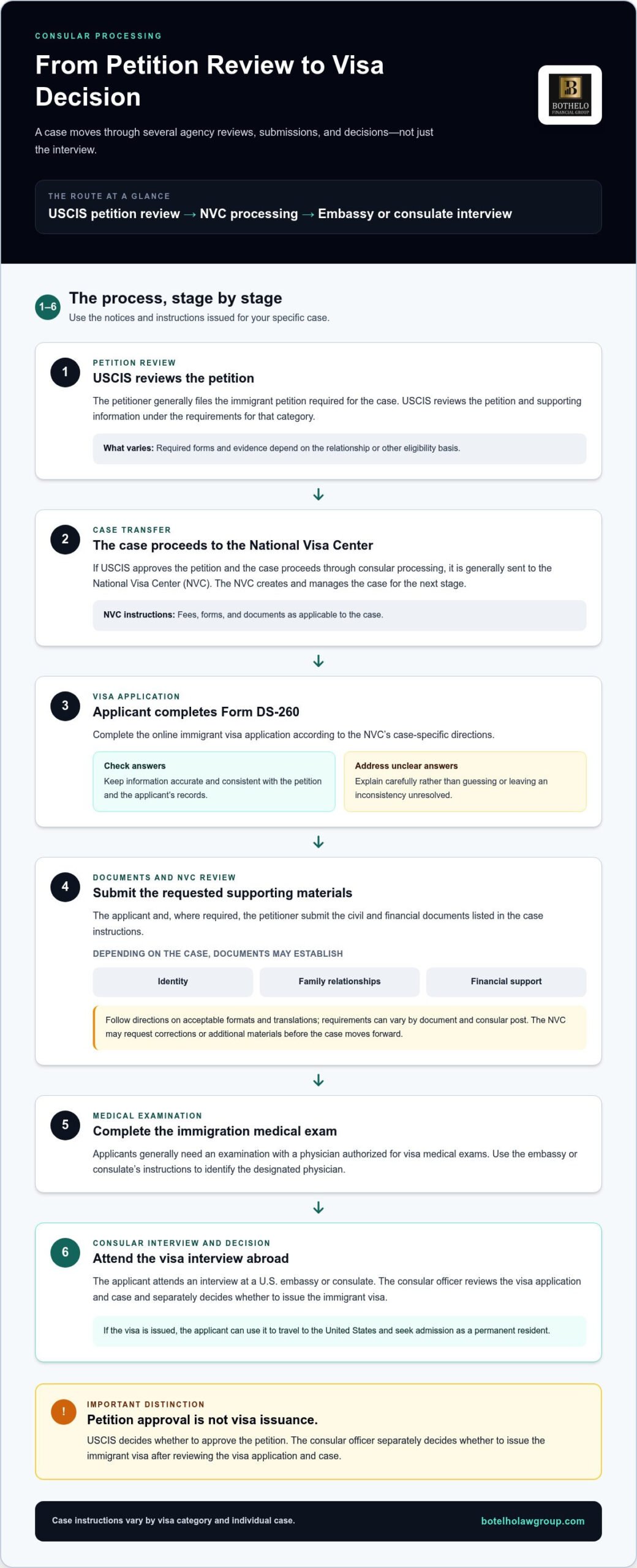
Consular processing involves a sequence of reviews, submissions, and decisions by different parts of the U.S. government. Instructions vary by visa category and case, so use the notices issued for your case as your guide. The Consular Processing on USCIS page provides an official overview.
From petition review to National Visa Center processing
- Petition review by USCIS: The petitioner generally files the immigrant petition required for the case, such as a family-based petition. U.S. Citizenship and Immigration Services reviews the petition and supporting information under the requirements for that category. The required forms and evidence depend on the relationship or other eligibility basis.
- Case transfer to the National Visa Center: If USCIS approves the petition and the case proceeds through consular processing, it is generally sent to the National Visa Center (NVC). The NVC creates and manages the case for the next stage, providing instructions for fees, forms, and documents as applicable.
- Immigrant visa application: The applicant completes Form DS-260, the online immigrant visa application, following the NVC’s case-specific directions. Check that answers are accurate and consistent with the petition and the applicant’s records. If an answer needs explanation, address it carefully rather than guessing or leaving an inconsistency unresolved.
Petition approval is not visa issuance. USCIS decides whether to approve the petition. The consular officer separately decides whether to issue the immigrant visa after reviewing the visa application and case.
Document review, medical examination, and consular interview
- Supporting documents and review: The applicant and, where required, the petitioner submit civil and financial documents identified in the case instructions. Depending on the case, these may include records establishing identity, family relationships, or financial support. Follow instructions about acceptable document formats and translations, as requirements can vary by document and consular post. The NVC reviews submissions and may request corrections or additional materials before the case moves forward.
- Medical examination: Applicants generally need an immigration medical examination with a physician authorized for visa medical exams. Use the embassy or consulate’s instructions to identify the designated physician, timing, and any records to bring. An examination with a provider who isn’t authorized for the process may not meet the case’s requirements.
- Consular interview and decision: At the interview, a consular officer reviews the application and relevant documents and asks questions to assess eligibility and issues raised by the record. The officer may request further information or take additional time to review the case. An interview doesn’t guarantee visa issuance. The decision depends on the individual facts and applicable requirements.
Keep copies of submitted materials and organize the originals you’re instructed to bring. If a notice is unclear or your case history raises questions, a consular processing attorney can help assess the issue and prepare for the next stage. Discuss your consular processing case with Botelho Law Group, based in Fall River, Massachusetts, which assists individuals abroad and represents immigration clients nationwide.
What Can Complicate Consular Processing, and What Applicants Should Understand
Completing every form is necessary, but it doesn’t resolve every question about eligibility or admissibility. Officials may compare application answers with supporting records and the applicant’s immigration history. Differences in dates, names, addresses, or descriptions of past events may prompt a request for clarification. That doesn’t mean a problem is inevitable, but it does make careful, consistent preparation important.
Missing evidence can leave a relevant point unexplained. For example, a document may not clearly establish a claimed family relationship, or an answer about a prior visa application may need context. Avoid guessing, overlooking inconsistencies, or submitting new information without considering how it relates to the existing record. A consular processing attorney can help assess the issue and organize a clear response based on the case facts.
Administrative processing and requests for more information
After an interview, a case may require administrative processing, meaning additional review before a decision can be completed. The consular post may also request documents or information. This step is not, by itself, a final visa decision. Timing and next steps vary by case, so follow the specific instructions you receive and provide requested materials in the stated manner. Don’t assume your case will follow another applicant’s experience.
Keep copies of notices and submissions, and note any response instructions or deadlines stated in the communication. If a request is unclear, or the documents could affect a prior answer, consider the full case history before responding. A focused, accurate submission can address what was requested without creating new inconsistencies.
Inadmissibility concerns, prior immigration history, and refusals
Previous immigration events can raise fact-specific legal questions. These may include earlier visa applications, entries to the United States, periods of stay, or past immigration decisions. The significance of an event depends on the underlying facts and applicable law. A brief description alone may not be enough to assess its effect. Be prepared to give truthful, consistent answers and explain relevant history when asked.
A visa refusal is a legal outcome based on the circumstances and applicable requirements of that case. The notice or explanation provided by the consular post can help identify the stated reason and any instructions about what may happen next. Don’t treat a refusal as interchangeable with administrative processing. Further review and a refusal are different case statuses, and the wording of the official notice matters.
In some situations, a waiver may be legally available, but waivers are specialized remedies, not automatic solutions. Eligibility depends on the specific legal ground and individual circumstances. Before deciding whether to pursue one, understand the applicable requirements, supporting evidence, and possible consequences. Individualized legal analysis can help distinguish a correctable documentation issue from a more complex eligibility concern and identify an appropriate next step. Not every complication has the same answer.
How to Prepare for Consular Processing Before the Interview
Preparation involves more than collecting paperwork. Aim to present a complete, organized record and answer questions accurately, using the instructions for your case as the controlling source. Requirements can differ by visa category and consular post, so use a general checklist only as a starting point, not as a substitute for official appointment and document instructions.
Start with these practical steps:
- Save copies of submitted forms, supporting records, notices, and case instructions in one secure location.
- Make a list of requested documents. Mark what you have gathered, what needs translation, and what needs follow-up.
- Review the application before the interview so you can recall the information you provided and identify any answer that needs a truthful explanation.
- Read the appointment instructions closely for requirements about arrival, documents, and materials you must bring.
Build a consistent and complete case file
Organize records so relevant information is easy to find. Keep civil documents, petition-related evidence, financial materials, and required translations in separate labeled groups, following the order or format stated in your case instructions. Prepare originals and copies only as directed. Don’t assume another applicant’s document list applies to your case.
Compare names, dates, addresses, and relationship details across forms and records. A spelling variation, a date that differs between documents, or a gap in a timeline may need clarification. Don’t alter a record or guess at an answer to make documents appear consistent. Identify discrepancies early, determine what the records show, and prepare a clear, accurate explanation where needed. For broader context on immigration representation and case preparation, see the firm’s immigration lawyer guide for Fall River.
Prepare for the interview and possible follow-up
Review the application and petition information before your appointment. Practice explaining relevant facts plainly, but don’t memorize a script or supply an answer you’re unsure about. If you don’t understand a question, ask for clarification. If you don’t know an answer, respond honestly rather than speculate. Interview preparation should help you communicate accurately, not change the underlying facts.
Arrange documents in the sequence required by the appointment instructions, with originals and copies separated if the post directs you to bring both. Keep confirmation notices and any requested medical or civil records with your case materials, but rely on the official list for what you need. Before traveling to the appointment, check for updated instructions from the consulate handling your case.
If the consular post requests additional information after the interview, read the notice carefully and respond to the stated request. Keep a copy of what you submit and a record of how it was delivered. A consular processing attorney can help review inconsistencies, organize evidence, and prepare for case-specific questions. Discuss your consular processing preparation with Botelho Law Group, which assists individuals abroad and represents immigration clients nationwide.
When a Consular Processing Attorney Can Help, and How to Take the Next Step
Consular processing involves several reviews and decisions, but not every applicant needs legal representation. Someone with a straightforward case may be able to follow the official instructions independently. When questions about eligibility, prior immigration events, or conflicting records arise, a consular processing attorney can provide individualized analysis, help organize evidence, and identify issues to address before the next filing or interview.
Legal guidance does not guarantee visa issuance. Its value is in understanding how the facts of a particular case relate to the process and preparing a clear, accurate record. Botelho Law Group, based in Fall River, Massachusetts, assists individuals abroad with consular processing and represents immigration clients nationwide.
Situations where individualized legal analysis may matter
Consider seeking case-specific guidance if an applicant has prior immigration history, a possible inadmissibility concern, a previous visa refusal, or information in the application that conflicts with supporting records. These facts don’t automatically determine the result, but they may affect what evidence or explanation is appropriate. A careful review can help distinguish a document gap from a more substantial legal issue.
Family cases also require attention to the qualifying relationship and petition category. The relationship between the petitioner and applicant, along with the petitioner’s immigration status, can shape the legal requirements and strategy. A general checklist can help with organization, but it can’t determine whether a specific person qualifies or how a past event affects the case. Those questions require analysis of the actual records and applicable law.
What to organize before seeking legal guidance
Gather the materials that show where the case stands and how it got there. Organizing them in advance can make a discussion more focused and help identify unanswered questions. Useful records may include:
- USCIS notices, petition copies, and records of prior filings.
- Copies of submitted visa applications and supporting evidence.
- Communications from the National Visa Center or U.S. embassy or consulate.
- Relevant travel and immigration records, including documents related to prior entries or applications.
Prepare a concise timeline of filings, travel, and significant immigration events. Include approximate dates only when exact dates aren’t available, and identify what you’re uncertain about rather than filling gaps with guesses. This context can help counsel see how an earlier event relates to the current application.
Before a legal discussion, write down your goal, the concerns you already know about, and any upcoming appointment, response date, or other deadline stated in official communications. Botelho Law Group can help clients abroad evaluate their case and prepare for the steps ahead without promising a particular outcome. For individualized guidance, speak with Botelho Law Group about your consular processing matter.
Move Forward With a Clear Plan for Your Case
Turn uncertainty into a focused plan by identifying the decision or deadline immediately ahead, the questions you still need answered, and any facts that could affect your options. Knowing those priorities can help you approach the process deliberately instead of reacting under pressure.
A consular processing attorney can review the circumstances behind your case and help you understand where legal analysis may be useful. Representation can’t guarantee a particular decision, but informed preparation can help you make considered choices and address concerns with greater clarity.
If you’re ready to discuss your circumstances, discuss your consular processing case with Botelho Law Group. The firm assists clients abroad and represents immigration clients nationwide, with a Massachusetts base in Fall River.
Frequently Asked Questions
What does a consular processing attorney do?
A consular processing attorney analyzes the case, helps identify legal or evidentiary issues, and advises on preparing filings and responding to government requests. For example, counsel may compare dates across prior visa applications and travel records to flag a discrepancy before an interview. An attorney can also explain the possible significance of a refusal or request for additional review, but can’t control the government’s decision.
How long does consular processing take?
There’s no single timeline because the petition category, agency workload, document review, and interview availability all affect the case. As of October 2026, USCIS estimated Form I-130 processing at 25.5 to 83.5 months for immediate relatives of U.S. citizens and 50 to 298 months for family preference categories. Those estimates cover petition processing, not the entire consular process. Check current agency and consulate updates for your case.
Can I use consular processing if I am already in the United States?
Possibly, but being in the United States doesn’t by itself establish which route is available or advisable. Some applicants may need to complete immigrant visa processing abroad, while others may qualify to apply for adjustment of status inside the country. Before departing the United States, get case-specific legal advice. Prior entries, periods of stay, or other immigration events may affect the consequences of travel and the options available.
Does USCIS petition approval mean my immigrant visa is approved?
No. Petition approval confirms that USCIS approved the underlying petition; it doesn’t mean the applicant has been issued an immigrant visa. The visa application and supporting record are considered separately, and a consular officer makes the visa decision. For example, approval of a relative petition doesn’t settle every question about the applicant’s eligibility or admissibility. Follow later case instructions and don’t make travel plans based only on petition approval.
What happens if a consular officer refuses my immigrant visa?
Review the written notice carefully because it should identify the reason or next step relevant to the case. A refusal may require additional documents, further review, or legal analysis of an eligibility concern. The notice’s specific wording matters. Keep the notice and related communications, and avoid refiling or submitting explanations without understanding the stated issue. An attorney can assess the decision and discuss whether a lawful next step may apply.
Do I need an attorney for consular processing?
No, representation isn’t mandatory in every case. Applicants with straightforward circumstances may be able to follow official instructions on their own. Legal guidance may be especially useful if records conflict, a prior immigration event raises questions, or the case involves a possible inadmissibility issue. An attorney can help evaluate those facts and organize a response, but can’t promise a visa or a particular outcome.
Can a consular processing attorney help someone living outside the United States?
Yes. An attorney can assist an applicant abroad by reviewing case documents, explaining notices, preparing for questions, and helping address issues raised during processing. For example, counsel may help organize a response when a consulate requests clarification about information in the application. Botelho Law Group assists people abroad with consular processing, including family-based cases. Legal representation can provide case-specific guidance while the applicant remains outside the United States.