
You notice unexplained bruising, a sudden decline, or a change in how your loved one is treated. It can be difficult to tell whether the cause is abuse, neglect, or a medical issue, but the concern deserves attention. If you’re searching for a nursing home abuse attorney Worcester MA families can turn to, start by addressing your loved one’s safety and making a clear record of what you’ve observed.
It’s understandable to feel uncertain about whom to notify, what information to keep, or whether speaking up could affect your loved one’s care. You don’t have to resolve everything at once. A measured response can help address immediate concerns while preserving information that may be useful later.
This guide covers warning signs, practical steps for protecting a resident, ways to document concerns, and reporting options in Massachusetts. It also explains how a personal injury attorney can review relevant records and facility responses, organize the available information, and help you understand potential civil claims. Every situation is different, but knowing what to do next can make a difficult moment more manageable.
Key Takeaways
- A concerning change in a resident’s condition deserves attention, but one sign alone doesn’t establish abuse or neglect.
- Evaluating a potential claim involves examining the care provided, the harm, how the two may be connected, and who may be responsible.
- Use a practical action plan: address immediate safety concerns, record observations, raise concerns, and preserve relevant documents.
- When considering a nursing home abuse attorney Worcester MA families can work with, look for clear communication, a thoughtful evidence plan, and an honest discussion of uncertainties and fees.
- A legal review can help organize known information and clarify potential civil claims and next steps, without guaranteeing an outcome.
Nursing Home Abuse in Worcester: Recognizing Warning Signs Without Jumping to Conclusions
A new bruise, a missed meal, or a sudden change in mood can be unsettling. One observation alone doesn’t prove abuse or neglect. Illness, medication, or an accident may offer another explanation. Still, a concerning change deserves attention. Families in Worcester can start with what they directly observe, whether it happens again, and what explanation the resident or facility provides.
Nursing home neglect is a failure to provide needed care that can put a resident’s health or safety at risk. A missed care task or unmet need may warrant questions, but doesn’t by itself establish that the facility was negligent. Suspected abuse generally involves intentional harmful conduct, such as hitting, intimidation, or improper restraint. An unexplained injury is an observation, not a conclusion. It could result from mistreatment, a fall, or a medical condition. The broader overview of Elder abuse describes forms of mistreatment and their potential consequences.
What signs may warrant closer attention?
Look across several areas rather than relying on a single clue. Physical observations may include recurring bruises, cuts, pressure injuries, or signs of dehydration. Emotional changes may include unusual fearfulness, withdrawal, or distress around a particular person. Care-related concerns can include poor hygiene, soiled clothing, missed assistance, or unexplained weight change. These are reasons to ask questions, not diagnoses or proof of wrongdoing.
Patterns matter. Note when a change appeared, whether it recurred, what the resident said in their own words, and how staff explained it. A new injury with no clear account, or explanations that conflict with what you observe, deserves follow-up. Some health conditions can affect appetite, mobility, skin, or behavior. Only an appropriate medical assessment can help evaluate those possibilities. Keep observations factual and separate what you saw from what you suspect.
When should a family treat a concern as urgent?
If your loved one faces immediate danger or needs emergency medical help, prioritize safety and contact emergency services. Don’t wait to collect records or determine whether the situation meets a legal definition. For a current but non-emergency safety concern, promptly raise it with the facility staff responsible for the resident’s care. Describe the specific issue, request a response, and record whom you spoke with and when.
Protection comes first. Decisions about formal reporting, preserving additional information, or speaking with a nursing home abuse attorney Worcester MA can come after immediate danger is addressed. A calm, specific account helps others understand the concern without treating an unverified explanation as fact.
How a Nursing Home Abuse Claim Is Evaluated Under Massachusetts Law
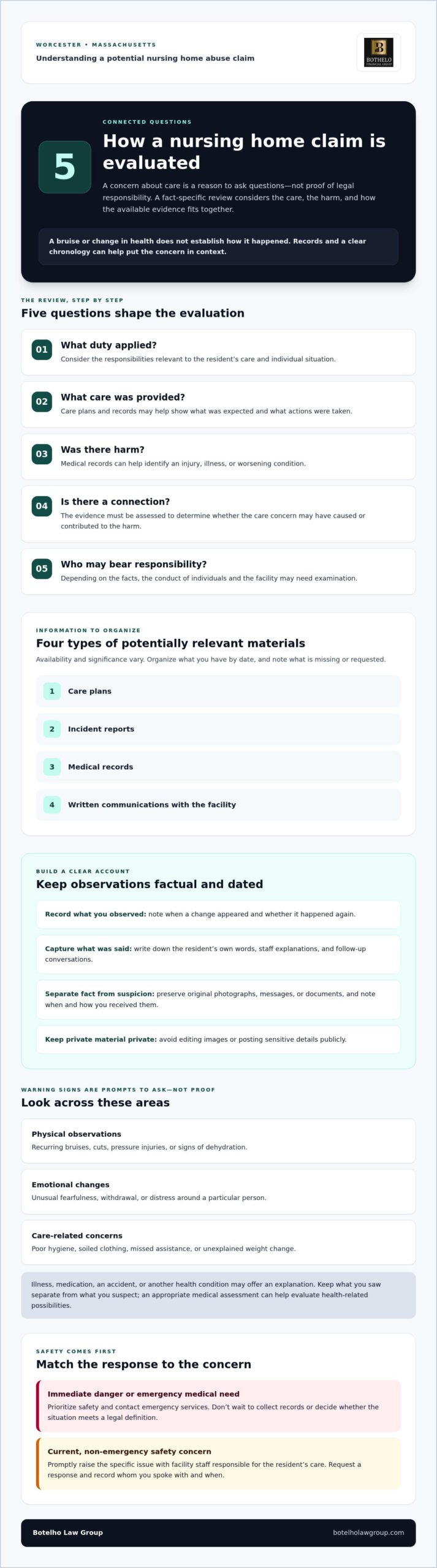
A concern about care is a reason to ask questions, not proof that a facility or caregiver is legally responsible. Evaluating a potential claim in Worcester requires a fact-specific review of what care was required, what actually happened, and whether the conduct may have caused harm. The review may also consider who provided or oversaw the care. The answer depends on the evidence and the resident’s circumstances.
A legal review commonly examines several connected questions:
- What duty applied? The review considers the responsibilities relevant to the resident’s care and situation.
- What care was provided? Care plans and records may help show what was expected and what actions were taken.
- Was there harm? Medical records can help identify an injury, illness, or worsening condition.
- Is there a connection? The evidence must be assessed to determine whether the care concern may have caused or contributed to the harm.
- Who may bear responsibility? Depending on the facts, the conduct of individuals and the facility may need examination.
Records and a clear chronology can help show how care concerns may relate to an injury, but they must be interpreted in context. A bruise or change in health does not establish how it happened. The relevant question is how the available information fits together.
Which records and observations may help clarify what happened?
Keep dated notes of what you observed, what the resident or staff told you, and any follow-up conversations. Separate direct observations from assumptions. If you already have photographs, messages, or documents, preserve the original files and note when and how you received them. Avoid editing images or posting sensitive details publicly, which could expose private information or obscure the original context.
Potentially relevant materials may include care plans, incident reports, medical records, and written communications with the facility. Their availability and significance vary. Organize what you have by date, and record which documents are missing or requested. A nursing home abuse attorney Worcester MA can review the materials and help identify questions that require further investigation.
Why may more than one person or organization need review?
Responsibility turns on the evidence, not an assumption that a single caregiver or the facility must be at fault. The review may examine individual actions, facility decisions, or how care was coordinated. In some cases, a qualified expert may be asked to assess medical or care-related issues. Expert review is one possible tool, not an automatic step or guarantee of a claim. No staffing violation or other breach should be assumed without supporting facts.
For families seeking a clearer assessment, discussing a potential personal injury claim can help organize known information and identify practical next steps. A legal evaluation can explain uncertainties without promising a particular outcome.
Choosing a Worcester Nursing Home Abuse Attorney: Questions That Reveal the Right Fit
Choosing legal counsel is a significant decision, especially when your family is trying to understand a loved one’s care and protect their interests. Look for a clear, measured evaluation rather than confident predictions. An attorney should explain what is known, what remains uncertain, and how the available information could be assessed. A useful discussion leaves your family with a clearer sense of the issues and practical next steps.
Use these points to assess how an attorney approaches a potential claim:
| Area | What to clarify |
|---|---|
| Case evaluation | Will the attorney identify the facts that matter and explain what cannot yet be determined? |
| Communication | Who will communicate with your family, and how will questions and updates be handled? |
| Evidence plan | What records or other information may help assess the circumstances? |
| Fee explanation | Are the proposed fee arrangement and its terms explained before representation begins? |
| Next steps | Will you leave with a practical understanding of what may happen next? |
What should an initial legal discussion clarify?
The conversation should begin with your family’s immediate concern, what is known about events, the resident’s condition, and any steps already taken. An attorney may ask about relevant documents and explain how they could be reviewed. The discussion should also identify potential legal questions, uncertainties, communication expectations, and reasonable next steps, without treating an allegation as established fact.
Pay attention to how the attorney responds to gaps or conflicting information. A careful explanation of what needs further review is more useful than an unsupported assurance. Families seeking a nursing home abuse attorney Worcester MA can use these questions to assess whether the discussion is specific, candid, and responsive to the resident’s circumstances.
How should families understand fees and case expectations?
Before representation begins, ask for a clear explanation of the fee arrangement and its terms. Personal injury matters may use a contingency arrangement, where fees depend on a recovery. Review the written agreement and make sure you understand how fees and case-related expenses are addressed.
No attorney should guarantee a result. Timing, possible claims, and outcomes depend on the evidence, the facts, and applicable law. Botelho Law Group handles personal injury matters in Massachusetts, including Worcester. A discussion with the firm can help your family understand potential issues and organize information without promising a particular outcome.
What Families Can Do Now: A Practical Worcester-Area Action Plan
A clear sequence can help you respond without losing sight of your loved one’s immediate needs. Take these steps where circumstances allow, but don’t delay urgent medical care or put yourself or the resident at risk to gather information.
- Address immediate danger. If your loved one needs emergency medical attention or faces immediate danger, contact emergency services. Don’t confront a person you suspect of causing harm.
- Record what you observe. Write down dates, times, locations, changes in condition, and actions you personally witnessed. Distinguish your observations from what someone else reported.
- Raise the concern with the facility. Contact the staff member responsible for the resident’s care or the facility’s management. Describe the specific concern, ask what steps will be taken, and keep a record of the conversation.
- Preserve relevant documents. Keep copies of messages, responses, photographs, and records you already have. Organize them by date and store them securely.
- Consider reporting and legal advice. After immediate safety needs are addressed, consider the appropriate reporting route and whether a legal review could help clarify potential options.
How can families document concerns while protecting privacy?
For each observation or conversation, note the date, location, people involved, and exact words where possible. Save written communications and facility responses in a secure folder, along with relevant records. Preserve original files rather than editing them. Limit sharing of sensitive health information to people and processes involved in addressing the concern. A concise, factual timeline can help prevent important details from being lost.
Which local and official resources may be relevant?
In Massachusetts, families can contact the Department of Public Health (DPH) about patient abuse in facilities. The DPH patient abuse hotline is 1-800-462-5540; reports may be made anonymously. For suspected elder abuse, the statewide Elder Abuse Hotline is 1-800-922-2275, available 24 hours a day, and reports can also be submitted online. Check the relevant agency’s current official instructions for reporting procedures and any follow-up steps.
Emergency services are for immediate danger or urgent medical needs, not routine questions about a complaint or legal claim. Families in Worcester can use the same statewide reporting routes; contacting an agency does not by itself determine whether a civil claim exists. If you’re considering a nursing home abuse attorney Worcester MA, a legal discussion may help organize the timeline and explain potential next steps. Discuss your concerns and potential legal options with Botelho Law Group, which handles Massachusetts personal injury matters, including Worcester.
Speak With Botelho Law Group About a Potential Worcester Nursing Home Abuse Claim
If you’re concerned about a loved one’s care, a focused legal discussion can help you sort through what is known, what remains unclear, and what options may merit further consideration. Botelho Law Group handles personal injury matters in Massachusetts, including Worcester. A review is not a guarantee that a claim exists or will succeed. Its purpose is to assess the information available and clarify practical next steps.
What information can families prepare before speaking with counsel?
You don’t need a complete case file before seeking legal guidance. A concise timeline and the materials already available can make the discussion more specific. Include the concern, the resident’s condition, conversations with facility staff, and actions your family has taken. Note unanswered questions, too.
- A brief chronology of concerns, injuries, facility conversations, and follow-up actions.
- Copies of relevant records, photographs, written communications, and facility responses, if available.
- Names and roles of people who may have relevant knowledge, along with questions about safety, reporting, privacy, fees, and the review process.
Keep original files where possible and share sensitive health information only through appropriate channels. If records are missing, note what you have requested or do not yet possess. A family seeking a nursing home abuse attorney Worcester MA can use this preparation to make the first conversation more organized without delaying urgent care or safety measures.
What happens after a family requests a legal review?
Counsel can review the information your family shares, identify relevant questions, and explain uncertainties that may affect the assessment. Depending on the circumstances, the discussion may clarify what additional information could be useful and which next steps warrant consideration. The review does not automatically establish responsibility, require an investigation, or mean that a claim will be pursued. Any legal options depend on the specific facts and applicable law.
If the resident has died, the family may also need to consider distinct legal questions related to a death. The firm’s Massachusetts wrongful death lawyer guide provides related information for that circumstance.
Bring your timeline and available documents, then ask what the information may show and what remains uncertain. Speaking with Botelho Law Group about a potential Worcester nursing home abuse claim can help your family understand possible legal issues and make informed decisions about what to do next. No particular result can be promised.
Take the Next Step With a Clearer Plan
You don’t need every answer before seeking guidance. If concerns remain, a focused legal discussion can help identify what is known, what still needs clarification, and which next steps may make sense for your family. The goal is not to force a conclusion before the facts are understood, but to make decisions with a clearer view of the available information and possible legal options.
Botelho Law Group is headquartered in Fall River and handles personal injury matters across Massachusetts, including Worcester. If you’re considering a nursing home abuse attorney Worcester MA, bring your questions and the information you have, even if your timeline or records are incomplete.
Discuss your concerns with Botelho Law Group to begin a conversation about your loved one’s circumstances and potential next steps. Take one decision at a time, with your family’s safety and interests at the center.
Frequently Asked Questions
What are common signs of nursing home abuse or neglect?
Common signs include injuries without a clear explanation, worsening hygiene, dehydration, unexpected weight changes, fearfulness, or a noticeable change in a resident’s mood or behavior. Consider whether the change is new, recurring, or different from the person’s usual condition. A resident may also seem reluctant to speak in front of certain people. These observations warrant attention, but they don’t establish what caused them. Medical assessment and further information may be needed.
How do I report suspected nursing home abuse in Massachusetts?
For suspected elder abuse, contact the Massachusetts Elder Abuse Hotline at 1-800-922-2275, available 24 hours a day, or submit a report online through the state’s reporting system. For patient abuse in a facility, contact the Massachusetts Department of Public Health (DPH) hotline at 1-800-462-5540. Check the agencies’ current instructions for reporting details. If someone is in immediate danger, contact emergency services rather than waiting to file a report.
Can I sue a nursing home for neglect in Worcester, Massachusetts?
Potentially, if the evidence supports a legal claim and connects a failure in care to harm. A concerning event alone doesn’t prove liability. A case-specific review may consider the resident’s circumstances, the care provided, the injury or loss, and whether the conduct caused or contributed to it. A nursing home abuse attorney Worcester MA families consult can assess potential civil options, but no claim or outcome can be determined without reviewing the facts.
How long do I have to file a nursing home abuse claim in Massachusetts?
Many Massachusetts personal injury claims, including most nursing home abuse or neglect claims, generally have a three-year filing deadline, measured from when the injury occurred or was discovered. Wrongful death claims generally have a three-year deadline from the date of death. The precise deadline can depend on the claim and specific facts. Don’t assume the time limit has passed or that it hasn’t; seek legal advice promptly to assess the applicable deadline.
What evidence should I collect if I suspect nursing home abuse?
Keep a dated record of what you personally observe, including when and where it happened, who was present, and what was said. Save relevant messages, letters, photographs, and any records already available to you. Note when you contacted the facility and what response you received. Preserve original files and avoid altering or publicly posting sensitive information. Don’t enter restricted areas or interfere with care to obtain evidence.
Can a nursing home make a resident sign away the right to sue?
Not every provision in an admission agreement automatically prevents a resident from pursuing a legal claim. Some agreements may contain arbitration or dispute-resolution terms, and their effect depends on the specific language, circumstances of signing, and applicable law. Don’t assume a clause is enforceable or invalid based on its title alone. Keep a copy of the complete agreement and have it reviewed before relying on it or deciding what options remain.
How much does a nursing home abuse attorney cost?
Personal injury cases may use a contingency fee arrangement, in which legal fees depend on a recovery. Botelho Law Group handles personal injury matters on a contingency basis, with no upfront legal fees unless the firm successfully recovers compensation. The agreement governs the actual terms, so review how fees and case expenses are addressed before representation begins. Ask questions about any provision you don’t understand; costs and case outcomes can’t be predicted in advance.