
Seeking legal protection in the United States is no longer just a matter of telling your story; it’s a high-stakes evidentiary battle where a single missing document can lead to a deportation order. You’re likely feeling the weight of the Boston Immigration Court backlog and the complexity of federal forms that often feel designed to confuse rather than assist. It’s natural to feel anxious when your future depends on navigating a system that’s increasingly rigid and unforgiving. The fear of removal is a heavy burden, especially when language barriers make technical legal requirements feel even more out of reach.
Securing a dedicated asylum lawyer Massachusetts can mean the difference between a successful claim and a devastating legal setback. This comprehensive guide provides a systematic breakdown of the asylum process, from establishing eligibility under the five protected grounds to preparing for the specific procedural demands of the local court system. We’ll examine the critical distinctions between affirmative and defensive applications and outline the precise evidence needed to build a resilient case. By understanding the methodical steps required for protection, you can move forward with the professional confidence needed to secure your status in 2026.
Key Takeaways
- Identify the specific legal grounds under the Immigration and Nationality Act that qualify you for protection in the United States.
- Determine whether your case follows the affirmative path through USCIS or the defensive path within the federal court system.
- Discover the essential corroborating documents and affidavits needed to satisfy the rigorous burden of proof for modern asylum claims.
- Gain a strategic overview of the Boston Immigration Court at the JFK Federal Building to ensure you’re prepared for Master Calendar Hearings.
- Learn how an asylum lawyer Massachusetts provides the precise litigation skills necessary to rebut government arguments and protect your future.
Understanding Asylum Eligibility in Massachusetts (2026)
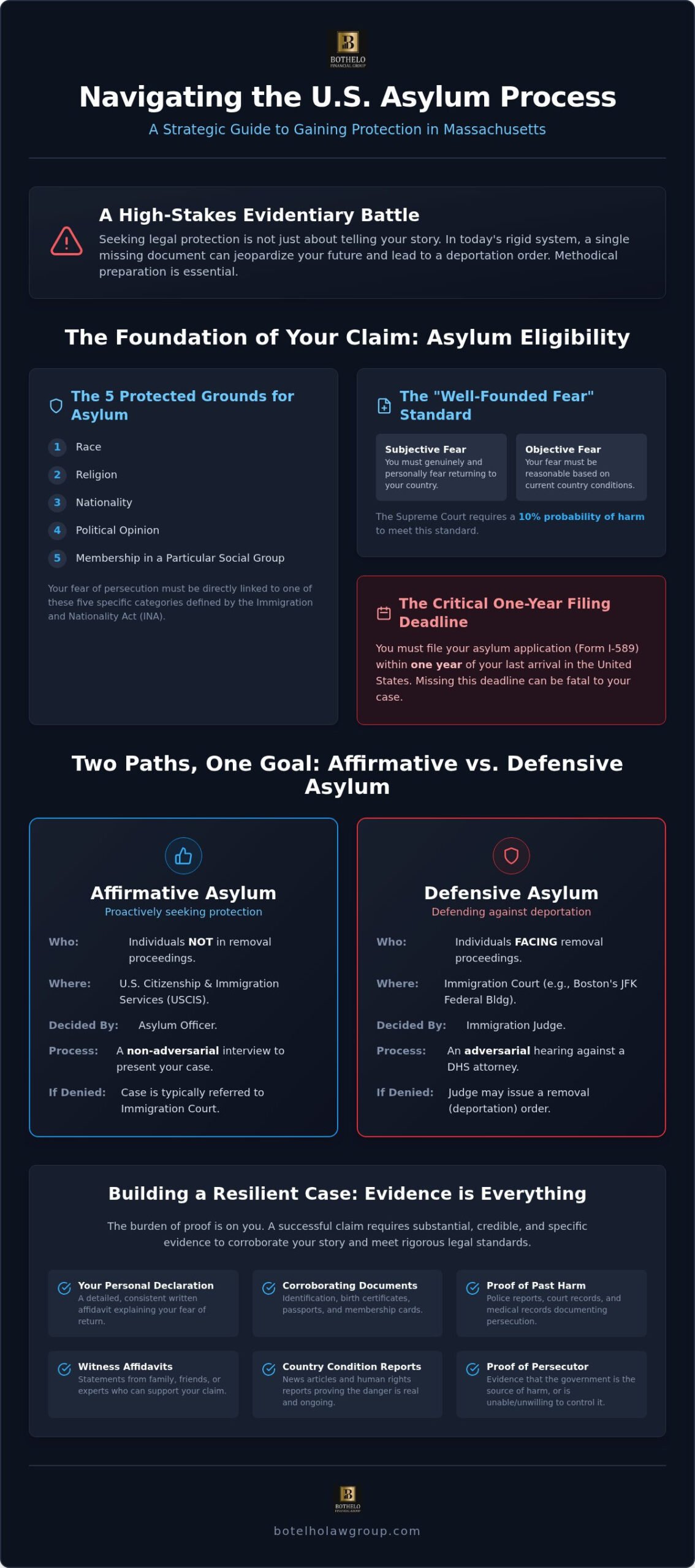
The Immigration and Nationality Act (INA) establishes the legal basis for asylum within the United States. This protection is reserved for individuals who are physically present in the U.S. or arriving at a port of entry. It isn’t a general provision for anyone seeking a better life; it’s a specific legal shield for those fleeing targeted harm. To qualify, you must demonstrate that you’re a refugee who cannot return home due to a well-founded fear of persecution. Working with a dedicated asylum lawyer Massachusetts is essential to ensuring your application meets these rigid federal standards from the outset.
A critical hurdle for many applicants is the one-year filing deadline. Federal law requires that you submit your asylum application within one year of your arrival in the United States. While exceptions exist for “changed circumstances” or “extraordinary circumstances,” these are difficult to prove without sophisticated legal strategy. Missing this deadline often shifts the case from an asylum claim to a more difficult request for Withholding of Removal, which offers fewer benefits and no path to citizenship.
The “Well-Founded Fear” Standard
Proving eligibility requires satisfying both subjective and objective components of fear. You must testify to a genuine, personal fear of returning to your country. However, your word isn’t enough. You must also show that your fear is objectively reasonable based on current country conditions. If you’ve suffered past persecution, the law grants you a presumption of future fear, shifting the burden to the government to prove you’d be safe. The Supreme Court has established that a well-founded fear is legally sufficient if there is a 10% probability of harm upon the individual’s return.
Protected Grounds: A 2026 Perspective
Your fear must be linked to one of five specific protected grounds: race, religion, nationality, political opinion, or membership in a particular social group. In 2026, the interpretation of these categories continues to evolve through federal case law. Political opinion claims now frequently include “imputed” opinions, where a persecutor targets you based on a belief they think you hold, even if you don’t. Nationality claims have become increasingly complex in multi-ethnic conflict zones, requiring precise evidence of ethnic or linguistic identity.
The source of the harm is equally vital. You must prove the persecution is carried out by the government or by a group the government is unable or unwilling to control. This often involves documenting the failure of local police or judicial systems to protect citizens from non-state actors like cartels or paramilitary organizations. An experienced asylum lawyer Massachusetts will help you gather the specific evidence needed to link your personal story to these broader legal requirements.
Affirmative vs. Defensive Asylum: Which Path Are You On?
The path to legal status depends entirely on whether the government has already initiated removal proceedings against you. If you’re in the United States and haven’t been placed in deportation proceedings, you’ll likely pursue affirmative asylum. This process involves an interview with an Asylum Officer from U.S. Citizenship and Immigration Services (USCIS). Conversely, if you’re facing removal, your claim is defensive. In this adversarial setting, an Immigration Judge decides your fate after hearing arguments from both your counsel and a government attorney. Determining which path applies to your situation is the first step an asylum lawyer Massachusetts will take to secure your protection.
The adjudicators in these two systems have different roles. An Asylum Officer conducts a non-adversarial interview to determine if you meet the refugee definition. If they don’t grant your application, they refer the case to the Immigration Court. At that point, the process becomes defensive. The Immigration Judge then conducts a fresh review of your claim, but this time, a Department of Homeland Security (DHS) attorney will be present to cross-examine you and challenge your evidence.
The Affirmative Asylum Timeline in Massachusetts
Your journey begins by filing Form I-589 with the appropriate USCIS service center. Once received, you’ll attend a biometrics appointment for background checks. The most critical stage is the asylum interview at the Boston Asylum Office. In 2026, processing times remain a significant concern due to systemic backlogs. While some cases are prioritized under current scheduling policies, many applicants face extended waiting periods before their interview date is set. It’s vital to maintain a current address with USCIS during this time to ensure you don’t miss high-stakes correspondence regarding your appointment.
The Defensive Asylum Process and Removal
Defensive asylum begins when you receive a “Notice to Appear” (NTA). This document charges you with being removable from the country and schedules your first Master Calendar Hearing. These preliminary hearings are procedural, where you’ll plead to the charges and set deadlines for filing your application. The final stage is the Individual (Merits) Hearing, which functions like a full trial. Because the stakes involve immediate deportation, you may also need to explore other forms of relief. A skilled cancellation of removal lawyer can determine if you qualify for alternative protections alongside your asylum claim. Navigating these court dates requires a systematic approach to evidence and testimony to overcome the government’s efforts to remove you.
Proving Your Case: Evidence and Documentation Requirements
The burden of proof in an asylum claim rests entirely on the applicant. While federal law allows for a grant of asylum based on testimony alone, the reality in 2026 is that corroborating evidence is almost always necessary to secure a positive outcome. Judges and asylum officers expect a robust evidentiary record that supports every claim made in your application. An asylum lawyer Massachusetts ensures your filing includes a systematic collection of documents designed to withstand intense government scrutiny.
Effective corroboration involves multiple layers of proof. We look for specific documents that anchor your personal narrative to verifiable facts, including:
- Affidavits: Sworn statements from witnesses who observed the persecution or have personal knowledge of the threats against you.
- Medical and Psychological Records: Documentation of physical injuries or clinical evaluations that confirm symptoms of Post-Traumatic Stress Disorder (PTSD) consistent with your story.
- Official Reports: Police reports or court documents from your home country, though we recognize these are often difficult to obtain in high-conflict zones.
- Country Conditions Reports: State Department and NGO reports that provide an objective baseline for the human rights situation in your region.
Expert witnesses often provide the decisive edge in complex litigation. We frequently engage country experts who can testify to specific political climates and medical experts who can validate the long-term impact of trauma. These professionals provide the objective context necessary to prove that your fear is well-founded.
Particular Social Group (PSG) Strategies
The “Particular Social Group” category is perhaps the most legally complex ground for protection. To qualify, a group must be socially distinct within its society and defined by an immutable characteristic that members cannot or should not be required to change. Common examples include claims based on gender, family lineage, or LGBTQ+ status. In 2026, case law in the First Circuit, which covers Massachusetts, requires precise litigation to prove that your specific group is recognized as a distinct entity by your community. We focus on building a record that satisfies these evolving legal definitions to prevent a denial based on “lack of social distinction.”
The Role of Credibility in Asylum Testimony
Your credibility is the foundation of your entire case. Any discrepancy between your written Form I-589 and your oral testimony can be used by a government attorney to challenge your honesty. We conduct rigorous preparation sessions to identify and address minor inconsistencies, such as dates or specific locations, before you ever step into a courtroom. The REAL ID Act mandates that an Immigration Judge may base a credibility determination on the applicant’s demeanor or responsiveness, regardless of whether an inconsistency goes to the heart of the asylum claim. This makes precision and composure during cross-examination a non-negotiable requirement for success. Partnering with a seasoned asylum lawyer Massachusetts provides the strategic oversight needed to protect your testimony from being unfairly discredited.
Navigating the Boston Immigration Court (JFK Federal Building)
The Boston Immigration Court, situated within the JFK Federal Building at 15 New Sudbury St., serves as the primary venue for defensive asylum cases in the region. This federal facility operates under strict security protocols and procedural rules that can be overwhelming for those unfamiliar with the system. Success in this environment requires more than just a valid claim; it demands a precise understanding of the court’s unique operational rhythm. Engaging a local asylum lawyer Massachusetts is essential to ensure you meet the specific expectations of the judges presiding over the Boston docket.
The process typically begins with a Master Calendar Hearing. These sessions are procedural in nature, focusing on pleadings, the filing of applications, and the setting of future deadlines. While these hearings are often brief, they carry significant legal weight. You are expected to arrive early, maintain professional decorum, and be prepared to respond to the charges listed in your Notice to Appear. Professional attire is not merely a suggestion; it reflects your respect for the court and the seriousness of your request for protection.
During these proceedings, you’ll face a Department of Homeland Security (DHS) trial attorney. This individual acts as the prosecutor for the government, tasked with scrutinizing your eligibility and highlighting any weaknesses in your evidence. Because each judge in the Boston court maintains distinct standing orders and evidentiary preferences, local representation is vital. A seasoned advocate understands these nuances and can tailor your case to the specific legal standards applied within the JFK Federal Building.
Preparing for the Individual Merits Hearing
The Individual Merits Hearing is the substantive trial where your asylum claim is finally decided. This hearing involves comprehensive testimony, the presentation of expert witnesses, and detailed legal arguments. Your counsel will lead you through a direct examination to establish the facts of your persecution, which is followed by a rigorous cross-examination by the DHS attorney. If you or a family member is currently in detention while awaiting these dates, you should immediately consult an immigration bond hearing lawyer to explore options for release during the pendency of your case.
Appealing a Denial: The Board of Immigration Appeals (BIA)
If the Immigration Judge issues an unfavorable decision, you have a strict 30-day window to file an appeal with the Board of Immigration Appeals (BIA). The BIA does not hear new testimony; it reviews the existing record to determine if the judge made errors of law or fact. This is a highly technical process that requires sophisticated legal briefing. In certain circumstances where new, life-altering evidence becomes available after a final order has been issued, a motion to reopen deportation case lawyer can evaluate whether you meet the rigorous criteria to have your case reconsidered.
How an Asylum Lawyer Protects Your Future in Massachusetts
Seeking asylum in 2026 requires more than a compelling narrative; it demands a rigorous adherence to evolving federal standards. An asylum lawyer Massachusetts provides the strategic oversight necessary to transform a personal history into a legally sound evidentiary package. From the moment you file Form I-589, every detail is scrutinized. We ensure that your application meets the strict filing standards of the current year, preventing the summary dismissals that often result from minor procedural oversights or missed deadlines.
Our role extends far beyond document preparation. In the adversarial environment of the courtroom, we act as your primary defense against the aggressive cross-examination of DHS trial attorneys. We anticipate their arguments, prepare expert rebuttals, and ensure that the judge hears the full, accurate context of your claim. This protective advocacy is designed to minimize risks and maximize the strength of your testimony under pressure. Without professional representation, many applicants find themselves overwhelmed by the technical objections raised by government counsel.
While your case is pending, we provide critical guidance on maintaining your legal status and securing work authorization. We manage the “asylum clock” meticulously to ensure you apply for an Employment Authorization Document (EAD) at the earliest possible date. This allows you to support yourself and your family legally while awaiting a final decision from USCIS or the Immigration Court. Our firm ensures that you remain compliant with all reporting requirements during this interim period.
The Botelho Law Group Approach to Protective Advocacy
At Botelho Law Group, we provide focused representation tailored to the unique facts of every case. We don’t believe in a generic approach to immigration law. Whether you’re filing an affirmative application or facing complex deportation defense, our team prioritizes precision in legal writing and relentless court representation. We understand that your future depends on our ability to navigate these systems effectively. Our firm serves as a dedicated partner, guiding you through every Master Calendar Hearing and Individual Merits trial with professional confidence. A seasoned asylum lawyer Massachusetts from our firm will fight to ensure your voice is heard and your rights are protected.
Securing Your Status and Beyond
Winning your asylum case is the beginning of a new chapter in the United States. One year after your asylum grant, you become eligible to apply for lawful permanent residency. This transition is vital for long-term security and eventually leads to naturalization. We also assist asylees in bringing their immediate family members to the U.S. through the I-730 Refugee/Asylee Relative Petition. If you’re looking to unite your family or transition to permanent status, consulting a family based green card attorney ensures that your subsequent filings are handled with the same level of expertise as your initial claim. Protecting your future means looking beyond the initial grant to ensure your entire family remains secure on American soil.
Securing Your Status in an Evolving Legal Landscape
Navigating the federal protection process in 2026 requires a disciplined approach to evidence and a strategic understanding of the Boston Immigration Court. You’ve learned that proving a well-founded fear involves more than just a personal statement; it demands a robust record of corroborating affidavits and country condition reports. Whether you’re pursuing an affirmative application or defending against removal at the JFK Federal Building, the procedural requirements are rigid and the stakes are life-altering. Success depends on your ability to meet these high evidentiary standards while managing complex court-specific rules.
Partnering with a seasoned asylum lawyer Massachusetts ensures that your case is built on a foundation of legal precision and protective advocacy. Botelho Law Group provides full-service representation in Fall River and Boston, specializing in complex litigation and deportation defense. We focus on securing your future by meeting every filing standard and rebutting government arguments with authority. Contact the Botelho Law Group for an Asylum Consultation Today to begin building your defense. Your safety and legal status are within reach when you have a dedicated strategist by your side.
Frequently Asked Questions
How long does the asylum process take in Massachusetts in 2026?
The timeline for asylum in Massachusetts varies significantly depending on whether your case is affirmative or defensive. In 2026, the Boston Asylum Office continues to face substantial backlogs, with some applicants waiting several years for an initial interview. Conversely, cases in the Boston Immigration Court are subject to the court’s specific docket speed. While some “last-in, first-out” policies exist, you should prepare for a process that typically spans two to five years from filing to a final decision.
Can I apply for asylum if I entered the U.S. illegally?
You can apply for asylum regardless of your manner of entry into the United States. Federal law allows individuals who entered without inspection to seek protection if they meet the refugee definition. However, an unauthorized entry may trigger defensive proceedings in the Boston Immigration Court rather than an affirmative process with USCIS. It’s vital to consult an asylum lawyer Massachusetts to ensure your entry circumstances don’t negatively impact your credibility or lead to immediate detention by immigration authorities.
When can I apply for a work permit after filing for asylum?
You are eligible to apply for an Employment Authorization Document (EAD) 150 days after filing a complete asylum application. USCIS cannot grant the permit until your application has been pending for at least 180 days. This “asylum clock” must remain running without applicant-caused delays. Any request to reschedule a hearing or interview can stop the clock, potentially delaying your ability to work legally while your case is being adjudicated in the Massachusetts system.
What is the difference between a refugee and an asylee?
The primary distinction between a refugee and an asylee is the physical location of the individual at the time of application. Refugees apply for protection from outside the United States, often through international resettlement programs. Asylees are already physically present in the U.S. or at a port of entry when they request protection. Both must meet the same legal standard of proving a well-founded fear of persecution based on one of the five protected grounds.
What happens if the Boston Immigration Court denies my asylum application?
If an Immigration Judge in Boston denies your claim, you have 30 days to file an appeal with the Board of Immigration Appeals (BIA). This appeal stays your deportation, meaning you cannot be removed while the BIA reviews the judge’s decision. If the BIA also issues a denial, you may be able to petition for review in the U.S. Court of Appeals for the First Circuit. These technical stages require precise legal briefing to identify specific errors made during your initial trial.
Can I include my spouse and children in my asylum application?
You may include your spouse and unmarried children under the age of 21 in your asylum application if they are currently present in the United States. They will be granted derivative asylum status if your application is successful. If your family members are outside the country, you must wait until your asylum is granted before filing Form I-730. This petition allows you to bring your immediate family to Massachusetts to join you as legally protected asylees.
Do I need an asylum lawyer for my USCIS interview?
While you aren’t legally required to have representation, an asylum lawyer Massachusetts is essential for a successful USCIS interview. An attorney ensures your testimony remains consistent with your written application and can intervene if the Asylum Officer asks improper or confusing questions. They also provide a closing statement that summarizes how your evidence meets federal legal standards. Having a professional advocate present reduces the risk of your case being referred to the Immigration Court for removal proceedings.
What is the one-year filing deadline for asylum?
The one-year filing deadline requires you to submit your asylum application within one year of your last arrival in the United States. Failure to meet this deadline generally makes you ineligible for asylum, though you may still qualify for Withholding of Removal. Exceptions are only granted for extraordinary circumstances or changed country conditions. Because these exceptions are difficult to prove, you should file your Form I-589 as soon as possible to preserve your eligibility for full asylum benefits.