
Most Massachusetts homeowners mistakenly believe a last will and testament is the ultimate shield for their estate, yet the reality is that a will acts as a mandate for a public, slow, and expensive court process. If you’re researching how to avoid probate in Massachusetts, you likely recognize that the typical 9 to 14 month delay and the public disclosure of your family’s assets are risks you shouldn’t have to take. It’s a valid concern; nobody wants their private financial legacy to become a matter of public record while legal fees steadily deplete the estate. You’ve worked hard to build your assets, and they should remain under your family’s control rather than the court’s jurisdiction.
This 2026 strategic guide provides the professional roadmap needed to bypass the probate system through precise asset architecture. We’ll explore the critical differences between wills and trusts, specifically focusing on how to protect a home in a market where median prices have reached $638,000. You’ll learn about non-probate transfers and the specific titling strategies that ensure your property passes directly to your heirs. By implementing these sophisticated legal mechanisms, you can secure your legacy and provide your family with the privacy and speed they deserve during a difficult transition.
Key Takeaways
- Understand how a Revocable Living Trust functions as a private contract to bypass the court and maintain your family’s absolute privacy.
- Discover how to avoid probate in Massachusetts by leveraging strategic asset titling and “operation of law” transfers to bypass the court system.
- Explore how Life Estates and remainder interests can protect your family home while ensuring an automatic transfer of ownership.
- Identify the specific legal mechanisms that eliminate the typical 12 to 18 month probate delay common in Bristol County.
- Map out a disciplined 2026 estate strategy that shields your legacy from public disclosure and prevents legal fees from depleting your assets.
The Reality of Probate in Massachusetts: Why Families Seek to Avoid It
The Massachusetts Uniform Probate Code (MUPC) serves as the legal framework for estate administration. While it provides a structured path for settling affairs, the reality for families in Bristol County is often a long, bureaucratic bottleneck. Understanding What is Probate? helps clarify why most homeowners seek to bypass it entirely. The timeline is a major factor; cases often languish for 12 to 18 months while families navigate filing fees that start at $390 for informal or formal petitions. During this period, the estate’s value is steadily eroded by these fees, legal costs, and executor commissions.
Privacy remains a paramount concern for many residents. Every document filed under the MUPC becomes a matter of public record. This means your family’s financial details, including specific asset valuations and the identities of your beneficiaries, are accessible to anyone who cares to look. It’s a high-stakes exposure that many families find intrusive and unnecessary, especially when sophisticated alternatives exist to keep these matters private.
The “Will” Misconception: Why a Simple Will is Not Enough
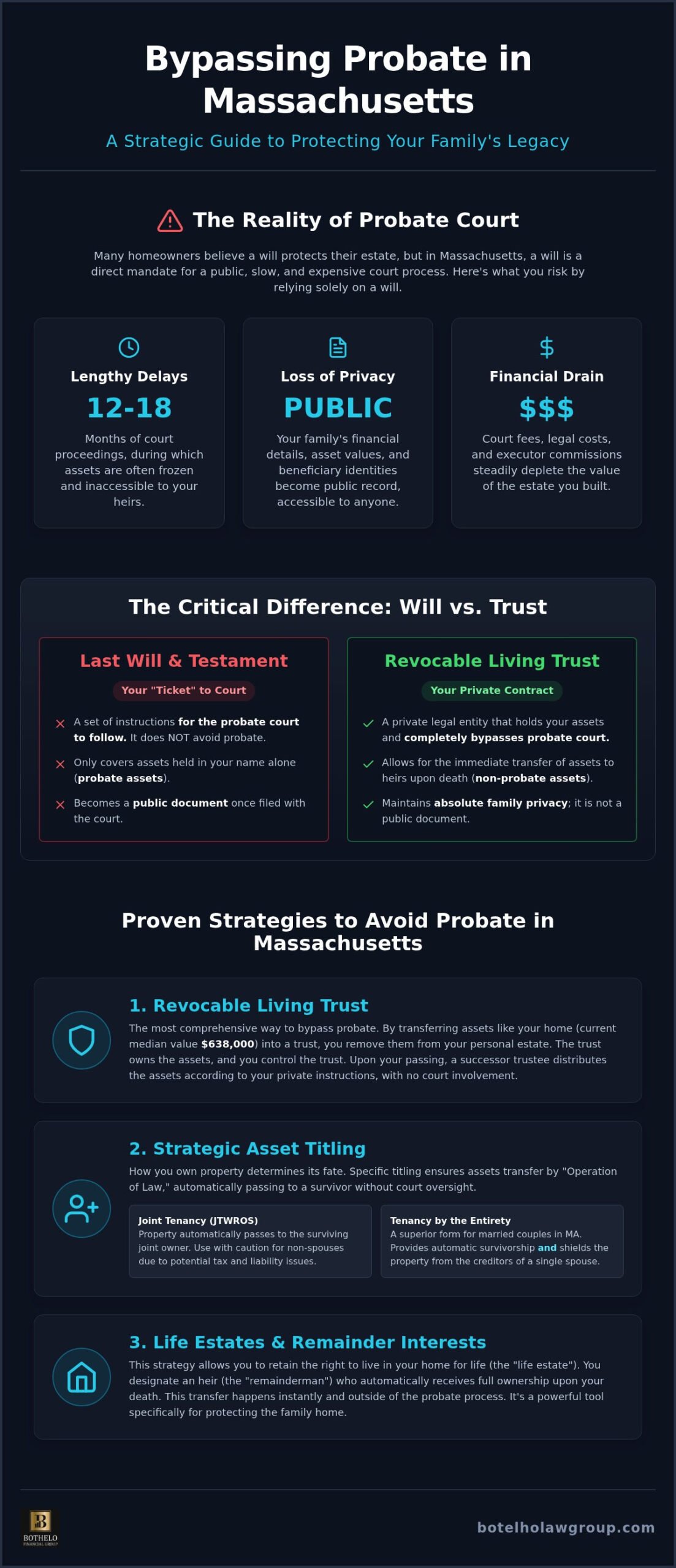
Many people believe that having a will is the primary method for how to avoid probate in Massachusetts, but this is a fundamental misunderstanding of the law. A will isn’t a bypass; it’s a set of instructions for the court to follow. In Massachusetts, a will is essentially a ticket to court, not a shield from it. If your strategy relies solely on a will, a judge must validate the document before any assets can be distributed to your heirs.
Clarity comes from distinguishing between probate and non-probate assets. Probate assets are those held in your name alone, which require court intervention to transfer. Non-probate assets pass by operation of law, such as through a trust or joint ownership with right of survivorship. Without these specific designations, even a well-drafted will cannot stop the court from taking control of your estate for a year or more.
High-Stakes Consequences of Failing to Plan
The costs of the status quo extend beyond dollars. When an estate enters probate, assets are often frozen. Heirs may struggle to access bank accounts to pay for final expenses or maintain the family home during the initial filing period. This financial paralysis creates unnecessary stress during a time of grief, leaving families vulnerable when they most need stability.
Creditors also benefit from the probate process. The law requires a mandatory notice period that allows them to make claims against your assets before your children receive their inheritance. Because these filings are public, they can also invite litigation from disgruntled parties. Learning how to avoid probate in Massachusetts is about protecting your family from these specific, predictable risks and ensuring your legacy remains a private matter.
Strategic Asset Titling: The Direct Path to Non-Probate Transfers
Asset titling is the most immediate answer for how to avoid probate in Massachusetts. When assets are structured to transfer by “Operation of Law,” they bypass the court’s jurisdiction entirely. This legal mechanism ensures that ownership shifts to a survivor or beneficiary the moment a death occurs. It’s a clean, private alternative to the lengthy processes described in Official Massachusetts Probate Information. By focusing on how your property is held, you can ensure that your most significant assets never enter the probate system.
Joint Tenancy with Right of Survivorship (JTWROS) is a common tool for this purpose. It allows property to pass automatically to the surviving owner. For married homeowners, Massachusetts offers a superior protection known as Tenancy by the Entirety. This specific form of ownership provides a shield against the creditors of a single spouse, a benefit that standard joint tenancy lacks. However, using JTWROS with non-spouses, such as children, requires caution. It can trigger unintended gift tax consequences or expose the property to the child’s legal liabilities.
Real Estate Ownership Strategies in Fall River
Your deed is the primary document governing the fate of your home. If your deed doesn’t explicitly state a right of survivorship, the property may default to a “Tenancy in Common,” which requires probate to transfer a deceased owner’s share. Reviewing your current deed is a critical first step. Many homeowners in the Fall River area discover their deeds are outdated, failing to reflect their current estate goals. Adding a child to a deed might seem like a simple solution for how to avoid probate in Massachusetts, but it often creates a “step-up” in basis issue, potentially costing heirs thousands in capital gains taxes later.
Strategic planning also involves preparing for periods where you cannot manage these titles yourself. A Power of Attorney Lawyer Fall River can help you establish the authority necessary to update titling or manage transfers if you become incapacitated. This ensures your probate avoidance strategy remains intact even if your health declines. If you’re unsure how your current assets are titled, a consultation with a Fall River asset protection strategist can provide the clarity needed to secure your estate.
Financial Accounts and Beneficiary Designations
Liquid assets like bank and brokerage accounts offer some of the simplest paths to probate avoidance. By establishing Payable on Death (POD) or Transfer on Death (TOD) instructions, you designate exactly who receives the funds upon your passing. These instructions act as a private contract with the financial institution, overriding whatever instructions might be in your will. For bank accounts, this is often referred to as an “In Trust For” (ITF) account.
The ultimate objective for many families is the “Empty Estate” goal. This strategy involves moving the bulk of your wealth into non-probate categories so that very little remains in your individual name at the time of death. By utilizing TOD registrations for brokerage accounts and POD designations for savings, you maintain full control of your money during your life while ensuring it’s available to your heirs within days of your passing. This prevents the court from freezing your liquidity during the 9 to 14 months it takes to resolve a typical case.
The Power of Trusts: Comprehensive Probate Avoidance and Asset Protection
A Revocable Living Trust is a sophisticated legal entity established to hold and manage your assets during your lifetime and beyond. Unlike a will, which serves as a set of instructions for a judge, a trust operates as a private contract. This distinction is the cornerstone of how to avoid probate in Massachusetts. Because the trust owns the assets, there is no need for court intervention to transfer ownership when you pass away. Your successor trustee simply follows the established instructions, maintaining absolute privacy for your family’s financial affairs.
A trust is only as effective as its “funding” phase. This involves the meticulous process of retitling your real estate, bank accounts, and other property into the name of the trust. An unfunded trust is essentially an empty vessel; it provides no protection and won’t prevent your assets from entering the court system. Precision in this administrative phase is what separates a functional estate plan from a costly failure. When implemented correctly, a trust ensures that your estate bypasses the 12 to 18 month delays common in the Bristol County probate system.
Revocable Living Trusts for Privacy and Control
Revocable trusts offer unparalleled flexibility for Massachusetts homeowners. You retain the power to change terms, add assets, or dissolve the trust as your family dynamics evolve in 2026. Beyond its role in how to avoid probate in Massachusetts, this instrument protects you during your lifetime. If you become incapacitated, your successor trustee steps in to manage your affairs immediately. This prevents the need for a court-appointed conservator, which can be an expensive and intrusive process. While court proceedings are public and slow, a trust allows for asset distribution to heirs within weeks, providing immediate stability for your loved ones.
Irrevocable Trusts for Advanced Asset Protection
For those seeking to shield wealth from potential creditors or legal judgments, an irrevocable trust provides a more robust layer of defense. By relinquishing the right to alter the trust, you move assets out of your personal reach and, consequently, out of the reach of most litigants. This is particularly relevant for Medicaid planning. Massachusetts enforces a 5-year look-back rule for asset transfers, making early implementation of an irrevocable trust vital for protecting the family home from nursing home costs.
Cross-border estate complexities also require specialized attention. If your estate includes international properties or business interests, integrating the expertise of an Employment Based Visa Attorney ensures that your asset protection strategy aligns with federal and international regulations. This holistic approach prevents legal friction and ensures that your non-probate transfers remain secure regardless of where your assets are located. Whether you’re protecting a local Fall River residence or international holdings, a trust provides the disciplined structure necessary to safeguard your legacy.
Life Estates and Beneficiary Deeds: Protecting the Family Home
A life estate is a powerful tool for homeowners seeking how to avoid probate in Massachusetts while retaining the right to live in their primary residence. By executing a life estate deed, you transfer the “remainder interest” to your heirs while reserving a “life interest” for yourself. This legal structure ensures that the property transfers automatically to the remaindermen upon your passing, bypassing the probate court entirely. It’s a disciplined approach to asset protection that provides immediate clarity for your beneficiaries.
One of the most significant advantages of a life estate involves its interaction with MassHealth. As of December 5, 2024, Massachusetts estate recovery is limited strictly to probate assets. Because a life estate creates a non-probate transfer, the home is generally protected from Medicaid liens after the life tenant passes away. However, you must account for the five-year look-back period for asset transfers. While a Nominee Trust might offer greater privacy, a life estate is often preferred for its direct impact on Medicaid planning and its ability to shield the family’s most valuable asset from court intervention.
The Mechanics of a Massachusetts Life Estate
Drafting a life estate deed requires precise language that meets the standards of Massachusetts registries of deeds. Errors in the “granting clause” can lead to title defects that take years to resolve. From a tax perspective, this strategy is highly beneficial; heirs typically receive a “step-up in basis” to the property’s fair market value at the time of your death. This can significantly reduce or eliminate capital gains taxes if they choose to sell the home later.
You must weigh these benefits against the “control” trade-off. Once a life estate is recorded, you cannot sell or mortgage the property without the written consent of the remaindermen. This loss of absolute autonomy is a serious consideration. If your family dynamics are complicated, this lack of unilateral control could become a liability. It’s vital to discuss these risks with an estate planning lawyer Fall River MA to ensure the deed aligns with your long-term autonomy and financial security.
Naming Beneficiaries for Retirement and Insurance
While real estate often requires complex deeds, liquid retirement assets like 401(k)s and IRAs are naturally designed to bypass court. These accounts are non-probate assets if you have designated specific individuals as beneficiaries. The most dangerous mistake a homeowner can make is naming “The Estate” as a beneficiary. Doing so drags these protected funds back into the probate process, making them subject to the 12 to 18 month delays and public disclosure you’re trying to avoid.
Coordinatig these designations is a critical step in how to avoid probate in Massachusetts. Your beneficiary forms must work in harmony with your trust or life estate strategy to prevent “gaps” in your plan. If you haven’t reviewed your designations since 2024, they may no longer reflect current legal standards or your family’s needs. To secure your legacy, contact Botelho Law Group for a comprehensive review of your asset titling and beneficiary architecture.
Crafting Your 2026 Estate Plan with Botelho Law Group
Success in estate planning requires more than just a collection of documents; it demands a disciplined, top-down analysis of your specific asset profile. At Botelho Law Group, we move beyond the limitations of a simple will to build a comprehensive framework for asset protection. When you partner with our firm, the goal is to provide a definitive answer for how to avoid probate in Massachusetts through a strategy tailored to your family’s unique needs. We act as focused advocates for your legacy, ensuring that the wealth you’ve built is shielded from the public, slow, and expensive court system.
Local expertise is vital when navigating the specific norms of the Bristol County probate system. Our deep roots in Fall River allow us to anticipate local court requirements and registry standards that out-of-state or generic services often overlook. By shifting from a reactive “will-based” mindset to a proactive “probate-proof” architecture, we provide you with the professional confidence that your heirs will be protected from unnecessary litigation and financial delays. Our results-oriented tone reflects the gravity of these matters; we treat every estate with the individual seriousness it deserves.
Our Systematic Planning Process
We utilize a highly structured, three-phase approach to ensure no detail is left to chance. This methodical approach ensures that every asset is accounted for, providing the most reliable roadmap for how to avoid probate in Massachusetts in 2026. The process includes:
- Phase 1: Asset Inventory and Titling Audit. We conduct a thorough review of your real estate deeds, financial accounts, and beneficiary designations to identify any “probate traps” currently existing in your estate.
- Phase 2: Architecture of Trusts and Life Estates. Our legal team designs the specific legal entities, such as Revocable Living Trusts or Life Estate deeds, that will house your assets and bypass court jurisdiction.
- Phase 3: Final Execution and Funding Guidance. We oversee the signing of all documents and provide the essential guidance needed to retitle your assets. As previously discussed, a trust is only effective if it is properly funded.
Take the Next Step in Fall River
Securing your family’s future starts with a confidential, results-oriented session at our Fall River office. During this meeting, our authoritative legal team will evaluate your current holdings and identify the most efficient path toward a non-probate transfer. To make the most of this consultation, we recommend bringing current property deeds, recent bank statements, and any existing estate documents for a comprehensive review. This preparation allows us to move quickly from general concepts to specific, actionable legal strategies.
Don’t leave your family’s inheritance to the default rules of the MUPC. You can protect your autonomy and ensure a seamless transfer of wealth by working with a full service law firm Fall River MA that specializes in high-stakes asset protection. Contact Botelho Law Group today to begin the process of shielding your family home and financial legacy from the reach of the probate court.
Secure Your Family’s Legacy Through Strategic Planning
Navigating the complexities of the Massachusetts Uniform Probate Code doesn’t have to be a burden for your heirs. By moving beyond a simple will and implementing a sophisticated architecture of trusts, life estates, and strategic asset titling, you ensure your estate remains a private matter. This proactive approach is the definitive solution for how to avoid probate in Massachusetts, allowing your assets to pass directly to your loved ones without court intervention or public disclosure.
The legal team at Botelho Law Group acts as a focused advocate for homeowners, providing the deep expertise in asset protection necessary to shield your life’s work. Our Fall River local office offers direct, professional counsel to help you transition from uncertainty to a probate-proof legacy. Don’t leave your family’s future to the default delays of the court system.
Protect Your Assets and Avoid Probate, Schedule a Consultation with Botelho Law Group Today. You’ve worked a lifetime to build your estate; we’re here to ensure it stays within your family exactly as you intended.
Frequently Asked Questions
Does a Will avoid probate in Massachusetts?
No, a will does not avoid probate; it serves as a legal mandate for the court to oversee the distribution of your assets. In Massachusetts, a will acts as a guide for the judge to follow during the 12 to 18 month court process. To bypass this public system, you must utilize non-probate transfer mechanisms such as trusts or strategic asset titling that operate outside the court’s jurisdiction.
How much does an estate have to be worth to go through probate in MA?
Any estate, regardless of its total value, must go through probate if assets are held in the deceased person’s individual name without a beneficiary designation. Even a small bank account can trigger a court filing. While estates valued under $25,000 may qualify for a simplified “Voluntary Administration,” any estate containing real property must undergo formal or informal probate to legally transfer the title to heirs.
What is the “Small Estate” threshold in Massachusetts for 2026?
For 2026, the threshold for a “Small Estate” or Voluntary Administration is $25,000 or less in personal property. This calculation excludes the value of one motor vehicle. Crucially, this simplified process is only available if the deceased did not own any real estate. If a home is involved, you cannot use this threshold and must pursue a standard probate filing unless the property was titled to bypass court.
Can I avoid probate without creating a trust in Massachusetts?
Yes, you can implement several strategies for how to avoid probate in Massachusetts without a trust. Using Joint Tenancy with Right of Survivorship or Tenancy by the Entirety for real estate ensures an automatic transfer to the surviving owner. Additionally, naming specific beneficiaries through Payable on Death (POD) or Transfer on Death (TOD) designations on financial accounts allows those funds to pass directly to heirs by operation of law.
How long do you have to file probate after death in MA?
Massachusetts law generally requires anyone in possession of a will to deliver it to the probate court within 30 days of the person’s death. While there is no strict deadline to open a formal probate estate, delaying the process can lead to complications with creditors, taxes, and the maintenance of property. Promptly initiating the process or confirming your non-probate strategy is essential to protecting the estate’s value.
What assets are exempt from probate in Massachusetts?
Assets exempt from probate include any property held in a trust, life insurance proceeds with a named beneficiary, and retirement accounts like 401(k)s or IRAs. Property owned jointly with a right of survivorship also bypasses the court. These assets transfer directly to the recipient by contract or law, shielding them from the public disclosure and administrative delays that characterize the standard Massachusetts probate system.
Is a Life Estate better than a Living Trust for avoiding probate?
A Life Estate is a direct, cost-effective tool for protecting a primary residence, but a Living Trust offers significantly more flexibility and control over your entire estate. While a Life Estate transfers a home automatically, it requires the consent of your heirs to sell or mortgage the property during your lifetime. A trust allows you to manage all types of assets and change your instructions as your family’s needs evolve.
How can a Fall River estate planning attorney help me save money on probate?
A Fall River attorney helps you save money by identifying “probate traps” in your current asset architecture before they become costly court battles. By restructuring your holdings into non-probate categories, you eliminate the need for $390 filing fees, legal costs, and executor commissions that typically deplete an estate. This disciplined planning ensures your legacy is preserved for your family rather than being consumed by the public court process.