
The PERM labor certification process is no longer just a regulatory hurdle; it’s a high-stakes strategic exercise where the Department of Labor acts more as an auditor than an administrator. A single error in your recruitment report or a slight miscalculation of the Massachusetts prevailing wage can derail a multi-year green card journey in seconds. If you’re feeling the weight of the 372-day average PERM processing time or the looming threat of visa retrogression, you understand the gravity of these filings.
It’s natural to worry that a technicality might trigger a devastating audit. Retaining an EB-3 visa lawyer Massachusetts ensures your petition is built on a foundation of legal precision rather than hope. We understand the anxiety that comes with long backlogs and the complex requirements of the 2026 immigration landscape. Our firm provides the protective advocacy needed to secure your permanent labor certification and move toward a successful I-140 approval.
This guide offers a methodical breakdown of the EB-3 process tailored for local employers and international talent. We’ll examine current prevailing wage trends, strategies to mitigate audit risks, and the specific timelines you can expect for green card issuance in the current fiscal year.
Key Takeaways
- Identify the specific eligibility requirements for Skilled Workers, Professionals, and Other Workers to ensure your petition aligns with the correct EB-3 visa category.
- Learn how a dedicated EB-3 visa lawyer Massachusetts meticulously prepares the PERM labor certification to withstand rigorous Department of Labor scrutiny and potential audits.
- Understand the employer’s ongoing obligation to demonstrate the ability to pay the prevailing wage within the Boston-Cambridge-Quincy metropolitan area.
- Gain a clear perspective on managing priority dates and responding effectively to visa retrogression trends throughout the 2026 fiscal year.
- Discover a methodical, results-oriented approach to case management that positions your employment-based green card petition for successful I-140 approval.
What is the EB-3 Visa? Categories for Massachusetts Professionals and Workers
The EB-3 visa represents the third preference for employment-based immigrant visas. It provides a pathway for foreign nationals to obtain permanent residency through a permanent job offer from a U.S. employer. Understanding What is an EB-3 Visa? is the first step for Massachusetts businesses looking to stabilize their workforce. Because the eligibility requirements are less stringent than those for EB-1 or EB-2, it’s often the most practical route for companies in the Commonwealth facing chronic labor shortages.
Selecting the correct sub-category is a high-stakes decision. A seasoned EB-3 visa lawyer Massachusetts ensures that the job description, educational requirements, and worker qualifications align perfectly. Misalignment at this stage often leads to immediate rejection during the labor certification phase. Our firm provides the methodical oversight required to categorize positions accurately from the outset.
EB-3 Professionals and Skilled Workers
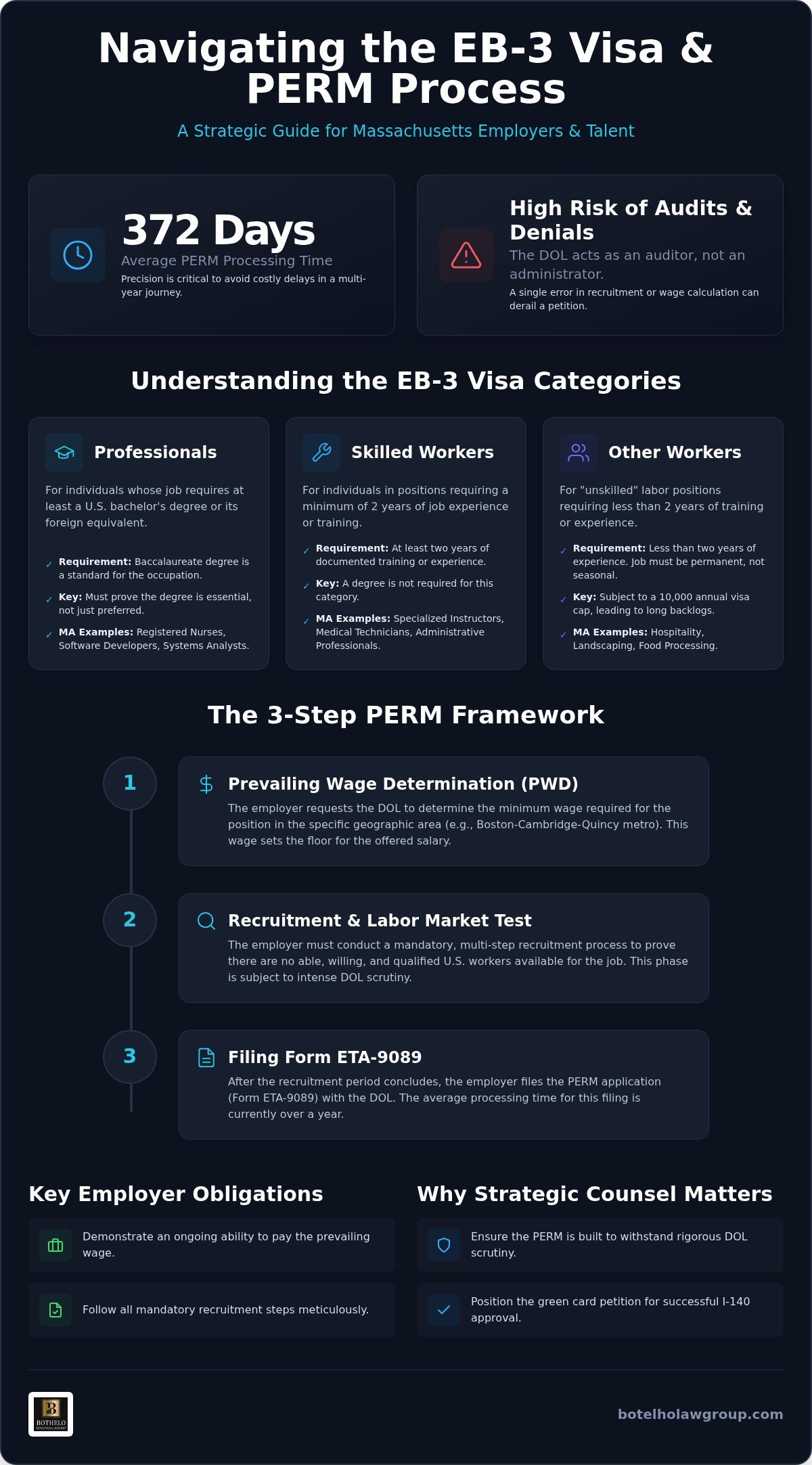
The Professionals sub-category is reserved for individuals who hold a U.S. baccalaureate degree or a foreign equivalent. The job offer must specifically require such a degree for entry into the occupation. In contrast, Skilled Workers are those whose positions require at least two years of training or experience. They aren’t required to have a degree, but they must prove their expertise through documented work history.
Massachusetts industries frequently utilize these categories to maintain their competitive edge. Examples include:
- Healthcare: Registered nurses and medical technicians in Boston’s hospital networks.
- Technology: Software developers and systems analysts in the Route 128 corridor.
- Education: Specialized instructors and administrative professionals in the state’s numerous academic institutions.
EB-3 Other Workers (Unskilled Labor)
The “Other Workers” category covers positions that require less than two years of training or experience. While often referred to as unskilled labor, these roles are essential to the New England economy. There is a consistent demand for sponsorship in sectors like hospitality, landscaping, and food processing. Unlike the other sub-categories, this group is subject to a specific annual cap of 10,000 visas globally, which often results in longer wait times and significant backlogs.
Precision in the job description is vital here. An EB-3 visa lawyer Massachusetts must demonstrate that the position is truly permanent and not temporary or seasonal. If the Department of Labor suspects the job is only for a specific season, the petition will fail. We act as a dedicated guide, ensuring your recruitment efforts and job definitions meet the rigorous federal standards for unskilled labor sponsorship.
Navigating the PERM Labor Certification Process in Massachusetts
The PERM process is the gatekeeper of the EB-3 category. It requires a Massachusetts employer to test the local labor market to prove that no able, willing, qualified, and available U.S. workers can fill the position. Because the Department of Labor (DOL) prioritizes domestic labor protection, this phase is subject to intense scrutiny. Any inconsistency between the job requirements and the candidate’s qualifications can lead to an immediate denial. It’s a high-stakes environment where a single administrative oversight can invalidate months of preparation.
As of late 2026, the average processing time for a PERM application is approximately 372 days. This timeline makes precision non-negotiable. Engaging a seasoned EB-3 visa lawyer Massachusetts allows employers to navigate these delays with a structured strategy that anticipates DOL objections before they arise. We provide the methodical oversight necessary to ensure your recruitment efforts meet federal standards while protecting the interests of both the company and the prospective employee.
The 3-Step PERM Framework
The journey begins with the Prevailing Wage Determination (PWD). As of August 31, 2026, the DOL is issuing determinations for requests filed in May 2026. This wage sets the floor for what the employer must pay once the green card is issued. Once the wage is established, the employer must conduct a mandatory recruitment campaign. This involves placing advertisements in newspapers of general circulation, posting job orders with the state workforce agency, and displaying internal office notices. After recruitment, the employer files Form ETA-9089. This begins the analyst review, which currently covers applications filed in November 2025 or earlier. Following these Official EB-3 Visa Requirements ensures the transition to the USCIS phase is seamless.
Avoiding Common PERM Pitfalls
Audits are the primary threat to a successful filing. The DOL frequently flags job descriptions that appear “unduly restrictive,” meaning the requirements are tailored too specifically to the foreign national rather than the actual business necessity. Documentation is another critical area. Employers must maintain a detailed recruitment report that justifies the rejection of every U.S. applicant based on lawful, job-related reasons. If the DOL suspects irregularities, they may mandate “supervised recruitment,” where the government oversees every step of the hiring process. This adds months of delay and significant administrative burden. Our firm acts as a protective advocate, ensuring your recruitment records are audit-ready from day one. If you need a methodical partner to manage these complexities, you can consult with our legal team for a structured evaluation of your recruitment strategy.
Massachusetts Employer Obligations: Prevailing Wage and Recruitment Rules
Employers in the Commonwealth face a rigorous set of financial and procedural obligations when sponsoring an EB-3 candidate. The Department of Labor (DOL) and USCIS require evidence that the sponsorship is a legitimate business necessity and that the employer can support the foreign national without displacing local talent. A key component of the PERM Labor Certification Process is the employer’s commitment to pay all associated legal and recruitment costs. Federal law strictly prohibits the foreign worker from paying for any portion of the PERM phase. This makes the employer the primary bearer of both cost and risk.
The wage itself is determined by the DOL based on the specific metropolitan statistical area. For companies in the Boston-Cambridge-Quincy region, these wage levels are often significantly higher than national averages due to the competitive local economy. An EB-3 visa lawyer Massachusetts helps employers understand these wage tiers early in the process to ensure the position is financially viable for the long term. We act as a dedicated guide to ensure that the wage determination aligns with the actual duties of the role while remaining compliant with federal standards.
Demonstrating Financial Ability to Pay
The employer must prove the “ability to pay” the offered wage from the date the PERM is filed until the green card is granted. This isn’t a one-time check; it’s a continuous obligation. USCIS typically requires federal tax returns or audited financial statements to verify this. For small to mid-sized businesses in Fall River or New Bedford, this requirement can be challenging if the company’s net income or net current assets don’t clearly exceed the offered wage.
Large employers with 100 or more workers may be exempt from submitting detailed financial statements if a high-level official signs a statement of financial capability. If your business doesn’t meet the 100-worker threshold, we methodically analyze your financials to determine if current wages paid to the beneficiary can bridge any gap in net income. This systematic review is essential to avoid an I-140 denial later in the process.
Local Recruitment Requirements in Fall River and Beyond
The recruitment phase is where many petitions fail due to inadequate documentation. In the Massachusetts market, the DOL requires specific advertising venues, including two Sunday editions of a newspaper of general circulation. We guide employers through the vetting process, ensuring that any U.S. applicants are rejected only for “lawful, job-related reasons.” This requires a disciplined approach to resume screening and interview protocols.
Our role involves a meticulous review of resumes and the final recruitment report. We protect the company’s interests by ensuring that no qualified U.S. worker was overlooked, which would otherwise lead to a PERM denial or audit. By maintaining a disciplined approach to these local recruitment rules, an EB-3 visa lawyer Massachusetts helps employers build a stable, legally compliant workforce while minimizing the risk of government interference.
Managing EB-3 Priority Dates and Visa Retrogression in 2026
The “Priority Date” represents a worker’s specific place in the queue for a green card. In the EB-3 category, this date is established the moment the PERM application is filed with the Department of Labor. Every month, the Department of State issues the Visa Bulletin, which tracks whether these dates are “current” or subject to backlogs. As of September 2026, skilled workers and professionals from most countries face a final action date of September 1, 2024. Those in the “Other Workers” sub-category face a much longer wait, with dates back to April 1, 2022. These timelines require a disciplined approach to long-term status management.
Retrogression occurs when the available visa numbers for a fiscal year are exhausted, causing the cutoff dates to move backward or stall. This creates significant anxiety for Massachusetts workers whose underlying non-immigrant status may be nearing expiration. An EB-3 visa lawyer Massachusetts acts as a strategic advocate during these periods, helping clients maintain legal presence through H-1B extensions or other status protections. We monitor these fluctuations with a methodical focus to ensure no filing window is missed when a date finally becomes current.
The I-140 Petition and Premium Processing
After the PERM is approved, the employer submits the I-140 Immigrant Petition to USCIS. The standard filing fee is $715. To avoid months of uncertainty regarding the petition’s merits, many utilize Premium Processing. Since March 1, 2026, the fee for this service is $2,965, which guarantees a decision within 15 business days. Approval of the I-140 is a major milestone. It locks in the priority date, which can often be ported to a new employer if a job change occurs under specific portability regulations. This provides the worker with a critical layer of professional mobility.
Concurrent Filing vs. Consular Processing
If the priority date is current and the worker is already in the U.S., they may file for an Adjustment of Status. This permits the worker to remain in the country and obtain a work permit while the green card is pending. For those currently outside the U.S., the process involves a consular processing attorney who coordinates with the National Visa Center and the relevant embassy. Managing travel and work authorization during these multi-year waits requires a disciplined legal strategy. If you need to evaluate your current standing on the Visa Bulletin, consult with our legal team for a timeline assessment.
Strategic Legal Representation for Massachusetts EB-3 Petitions
Botelho Law Group operates from our Fall River headquarters, providing a localized, accessible partnership backed by the resources of a nationwide authority. Securing a permanent labor certification requires more than just filling out forms; it demands an EB-3 visa lawyer Massachusetts who acts as a sophisticated legal strategist. We provide protective advocacy for both the sponsoring employer and the foreign worker, ensuring that the gravity of these legal matters is met with professional confidence and meticulous case management.
Our firm treats the EB-3 process as a high-stakes recruitment exercise where the margin for error is zero. We don’t just react to government actions; we anticipate them. By building a comprehensive record of recruitment and financial capability from day one, we position our clients to overcome the hurdles of the 2026 immigration landscape. This methodical approach is designed to instill trust and provide a clear, results-oriented path toward permanent residency.
A Disciplined Delivery of Legal Services
We don’t leave approvals to chance. Our team provides a structured breakdown of the EB-3 timeline tailored to the specific needs of your industry and country of chargeability. Whether you’re a healthcare provider in Boston or a manufacturing firm in Fall River, we manage every detail of the employment-based visa navigation process. Our attorneys are relentless fighters for your interests, meticulously preparing all filings to maximize approval chances while minimizing the risk of a Request for Evidence (RFE).
- Comprehensive preparation for the final green card interview at USCIS field offices.
- Strategic responses to complex audits or supervised recruitment mandates.
- Direct access to seasoned advocates who prioritize clear, high-stakes communication.
Beyond the Visa: A Full-Service Partnership
Our advocacy doesn’t end with the issuance of a green card. We offer long-term support that spans from the initial PERM filing through eventual naturalization and citizenship applications. Because our firm also handles estate planning, asset protection, and personal injury litigation, we’re uniquely positioned to protect your broader interests as you establish your future in the United States. This holistic approach transforms a transactional legal service into a full-service partnership that values individual seriousness for every case.
Success in 2026 requires a stable and reliable legal presence. You shouldn’t face the complexity of the Department of Labor or USCIS alone. Secure your workforce or your future; Contact Botelho Law Group for an EB-3 consultation today to begin your methodical path to permanent residency.
Securing Your Professional Future in Massachusetts
The path toward an EB-3 green card in 2026 demands more than just administrative compliance; it requires a disciplined legal strategy that anticipates federal scrutiny at every stage. Success depends on meticulous documentation of the PERM recruitment process and a deep understanding of local prevailing wage requirements. While visa retrogression and extended processing timelines present significant challenges, these are hurdles that can be overcome with a methodical approach and expert oversight.
Partnering with a seasoned EB-3 visa lawyer Massachusetts ensures that your petition is handled with the gravity it deserves. Botelho Law Group provides sophisticated legal representation from our Fall River headquarters, serving as a dedicated guide for employers and workers nationwide. We act as focused advocates who prioritize your long-term stability and professional growth. Don’t leave your immigration status to chance in an increasingly complex regulatory environment. Schedule a Consultation with an EB-3 Visa Lawyer today to begin your systematic path to permanent residency. We’re ready to provide the protective advocacy your case requires.
Frequently Asked Questions
How long does the EB-3 visa process take in 2026?
The total timeline for an EB-3 visa typically ranges from 18 to 24 months, though individual cases vary based on Department of Labor processing. As of August 2026, the PERM labor certification stage alone averages approximately 372 days. This is followed by the I-140 petition and, depending on your priority date, the adjustment of status. Consult an EB-3 visa lawyer Massachusetts to establish a realistic timeline based on current retrogression dates in the monthly Visa Bulletin.
Can I change employers while my EB-3 green card is pending?
You may change employers under the “portability” provisions of the American Competitiveness in the 21st Century Act (AC21) if specific conditions are met. Your I-140 petition must be approved, and your Form I-485 must have been pending for at least 180 days. The new position must be in a same or similar occupational classification. Our firm provides methodical oversight to ensure your new job offer complies with these strict federal requirements without jeopardizing your residency.
What is the minimum salary required for an EB-3 visa in Massachusetts?
There is no fixed minimum salary; instead, the employer must pay the prevailing wage as determined by the Department of Labor. This wage is based on the specific job duties, required experience, and the geographic location of the workplace. In competitive markets like the Boston-Cambridge-Quincy area, these wages are often higher than national averages. We systematically review your job description against current DOL data to ensure the wage determination is accurate and financially viable for the employer.
Does the employer have to pay for the EB-3 lawyer?
Federal regulations mandate that the employer must pay all costs associated with the PERM labor certification phase, including legal fees and recruitment advertising. The foreign worker is strictly prohibited from paying these specific expenses. However, the worker or the employer may pay the fees for the I-140 petition and the adjustment of status application. Our firm ensures that all fee structures remain compliant with Department of Labor rules to avoid potential audits or petition denials.
What happens if my PERM labor certification is audited?
If the Department of Labor issues an audit, the employer must submit a comprehensive recruitment report and all supporting documentation within 30 days. An audit typically adds several months to the processing timeline. As of August 2026, the DOL is reviewing audited PERM applications filed in December 2025. We act as protective advocates, preparing every filing to be audit-ready from the start to minimize delays and ensure your recruitment efforts withstand rigorous federal scrutiny.
Can my family join me on an EB-3 visa?
Your spouse and unmarried children under the age of 21 are eligible to accompany you as derivative beneficiaries. They can apply for green cards concurrently with your adjustment of status or through follow-to-join consular processing. Once approved, they receive the same permanent resident status as the primary applicant, allowing them to live, work, and attend school anywhere in the United States. We provide full-service representation to ensure your family’s applications are processed with the same precision as your own.
Is there a difference between EB-3 and H-1B visas?
The H-1B is a non-immigrant visa that allows for temporary employment, usually for a maximum of six years. In contrast, the EB-3 is an immigrant visa that leads directly to a permanent resident card. While many workers in Massachusetts use an H-1B as a stepping stone, the EB-3 provides a permanent solution to labor needs. An EB-3 visa lawyer Massachusetts can help you transition from temporary status to permanent residency through a methodical, multi-step filing strategy.
What is the “Other Workers” category for unskilled labor?
The “Other Workers” category is a sub-classification of the EB-3 visa for positions requiring less than two years of training or experience. This includes essential roles in hospitality, agriculture, and manufacturing. While it’s a vital pathway for the New England workforce, it’s subject to a strict annual cap of 10,000 visas. This limitation often results in longer priority date backlogs compared to the skilled worker or professional categories, requiring a disciplined approach to status management.